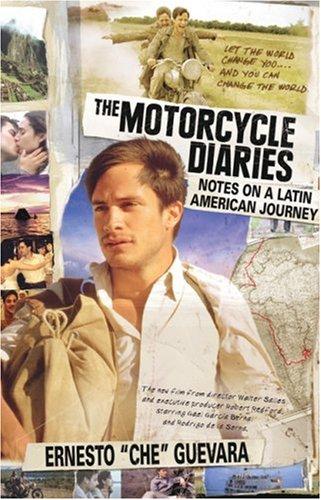
Talk to The Motorcycle Diaries: Notes on a Latin American Journey like its author wrote you back.
Get the ideas that fit your life — not generic summaries.
- Chat with the book
- Audiobook-style main ideas
- Adapts to your life and goals
- Helps you take action
The Motorcycle Diaries: Notes on a Latin American Journey, in detail
In January 1952, twenty-three-year-old Ernesto Guevara and his friend Alberto Granado set off from Buenos Aires on a 500cc Norton motorcycle they called La Poderosa — The Mighty One — planning to traverse South America. The motorcycle broke down repeatedly and was eventually abandoned. They traveled the rest of the way by any means available: hitchhiking, cargo boats, trucks, and on foot. The Motorcycle Diaries is Guevara's travel journal of those nine months, published posthumously in Spanish in 1992 and translated widely after the 2004 film adaptation.
The journey covers Argentina, Chile, Peru, Colombia, and Venezuela. What Guevara documents is less the travel itself — although the adventures are vivid — than the human landscape he encounters along the route. The indigenous communities of the Peruvian altiplano. The copper miners at Chuquicamata, owned by an American company and managed with contempt for the Chilean workers. The leper colony at San Pablo on the Amazon, where Guevara swam across the river on his birthday to celebrate with patients who were prohibited from contact with the medical staff.
The political analysis is not yet the Guevara of Cuban fame. The journal reads as a young man noticing poverty with genuine feeling rather than a revolutionary issuing diagnoses. There are passages of self-conscious romanticism, long descriptions of Andean landscape, and honest accounts of the pair's dependency on the generosity of strangers. The writing is uneven — this was a private journal, not a manuscript prepared for publication — but the observations of structural inequality in mid-century Latin America are clear-eyed and specific.
The book is most useful read alongside the history it documents and the history Guevara subsequently made. As a travel memoir, it is good but not exceptional. As a document of a consciousness in formation — the moment before political commitment hardened into ideology — it is something rarer. The footnotes added by Granado and Guevara's widow add useful context without overinterpreting what the younger Guevara would have thought about his older self.
The big ideas
- 1.
Guevara's encounter with the Chuquicamata copper miners — owned by an American company and treating Chilean workers as expendable — was among the formative political experiences the diary documents.
- 2.
The journey revealed Latin America as a single connected continent rather than a collection of separate national experiences — a pan-American consciousness that Guevara later carried into his revolutionary politics.
- 3.
The leper colony at San Pablo demonstrated Guevara's medical ethics in practice: his refusal to wear gloves, his willingness to be physically present with patients, his contempt for medical hierarchy that served status rather than care.
