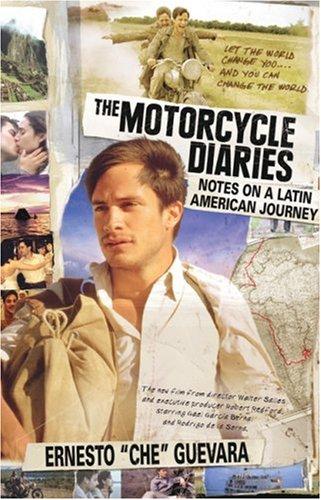
The Motorcycle Diaries: Notes on a Latin American Journey by Ernesto Che Guevara is a 2003 memoir book about travel, political awakening, identity. Guevara's encounter with the Chuquicamata copper miners — owned by an American company and treating Chilean workers as expendable — was among the formative political experiences the diary documents.
Summary
In January 1952, twenty-three-year-old Ernesto Guevara and his friend Alberto Granado set off from Buenos Aires on a 500cc Norton motorcycle they called La Poderosa — The Mighty One — planning to traverse South America. The motorcycle broke down repeatedly and was eventually abandoned. They traveled the rest of the way by any means available: hitchhiking, cargo boats, trucks, and on foot. The Motorcycle Diaries is Guevara's travel journal of those nine months, published posthumously in Spanish in 1992 and translated widely after the 2004 film adaptation.
The journey covers Argentina, Chile, Peru, Colombia, and Venezuela. What Guevara documents is less the travel itself — although the adventures are vivid — than the human landscape he encounters along the route. The indigenous communities of the Peruvian altiplano. The copper miners at Chuquicamata, owned by an American company and managed with contempt for the Chilean workers. The leper colony at San Pablo on the Amazon, where Guevara swam across the river on his birthday to celebrate with patients who were prohibited from contact with the medical staff.
The political analysis is not yet the Guevara of Cuban fame. The journal reads as a young man noticing poverty with genuine feeling rather than a revolutionary issuing diagnoses. There are passages of self-conscious romanticism, long descriptions of Andean landscape, and honest accounts of the pair's dependency on the generosity of strangers. The writing is uneven — this was a private journal, not a manuscript prepared for publication — but the observations of structural inequality in mid-century Latin America are clear-eyed and specific.
The book is most useful read alongside the history it documents and the history Guevara subsequently made. As a travel memoir, it is good but not exceptional. As a document of a consciousness in formation — the moment before political commitment hardened into ideology — it is something rarer. The footnotes added by Granado and Guevara's widow add useful context without overinterpreting what the younger Guevara would have thought about his older self.
Talk to The Motorcycle Diaries: Notes on a Latin American Journey like its author wrote you back.
Get the ideas that fit your life — not generic summaries.
- Chat with the book
- Audiobook-style main ideas
- Adapts to your life and goals
- Helps you take action
Key takeaways
- 1.
Guevara's encounter with the Chuquicamata copper miners — owned by an American company and treating Chilean workers as expendable — was among the formative political experiences the diary documents.
- 2.
The journey revealed Latin America as a single connected continent rather than a collection of separate national experiences — a pan-American consciousness that Guevara later carried into his revolutionary politics.
- 3.
The leper colony at San Pablo demonstrated Guevara's medical ethics in practice: his refusal to wear gloves, his willingness to be physically present with patients, his contempt for medical hierarchy that served status rather than care.
- 4.
The diary is a private document, not a polished book. Its unevenness — the self-pity alongside the acuity, the romantic landscape writing alongside the political observation — is part of its value as a historical record.
- 5.
The friendship between Guevara and Granado is the book's emotional spine. Their partnership — complementary personalities, genuine mutual affection — carries the narrative through its less eventful passages.
- 6.
Mid-twentieth-century South America, as the diary documents it, was marked by the legacy of Spanish colonialism, American economic domination, and the specific poverty of indigenous and mestizo communities that neither had served.
- 7.
Guevara was a medical student during the journey, not yet a political actor. The transition the diary documents — from observer of suffering to someone convinced that suffering required a political response — is gradual rather than sudden.
- 8.
The film adaptation by Walter Salles (2004) is faithful to the emotional arc of the diary but significantly romanticizes Guevara. Readers of the book should expect a scruffier, more ambivalent narrator than Gael García Bernal's version.
Discussion questions
Use these on your own, with a book club, or as chat starters in Superbook. Book club version, ready to copy or print →
- 1.
Guevara was twenty-three when he made this journey. How much of what he observed would he have seen differently at thirty-three, or forty-three? Does age change political seeing?
- 2.
The copper miners at Chuquicamata are one of the diary's most affecting episodes. Guevara observes American corporate ownership and Chilean worker poverty without yet having a fully developed political framework for it. Does that observation feel different to you knowing who Guevara became?
- 3.
The diary is private writing made public. Should we read it as a confession, a document, or a literary memoir? Does its origin as a journal change how we evaluate its claims?
- 4.
Guevara and Granado depended on the generosity of strangers throughout the journey. What does that dependency tell us about privilege, and about the gap between travelers and the people they encounter?
- 5.
The San Pablo leper colony episode has become one of the most celebrated passages in the book. What do you think Guevara was demonstrating with the river swim, and to whom?
- 6.
How do you read a memoir by someone whose subsequent life was defined by political violence? Does knowing what Guevara did in Cuba, Bolivia, and the Congo affect how you experience the younger voice in this book?
- 7.
The book is widely taught in Latin American history and political philosophy courses. What does the use of a future revolutionary's early diary as pedagogy assume about the relationship between biography and politics?
- 8.
Guevara describes the indigenous communities of the Andes with admiration and at times with exoticizing romanticism. How do you read that tension in a 1952 document written by an Argentine of mixed European descent?
- 9.
Have you ever taken a journey — long or short — that changed how you saw a political or social issue? What made the travel, rather than just reading, decisive?
- 10.
The motorcycle breaks down early and they continue without it. What does that detail — the failure of the original plan, the improvisation — say about how major journeys actually unfold?
- 11.
Granado's footnotes appear in some editions. How do you think a long friendship shapes memory, and does having two accounts of the same journey clarify or complicate the record?
- 12.
What version of Latin America does the diary give access to, and what does it miss? Whose experiences are not in the book?
Themes
Frequently asked questions
-
Is The Motorcycle Diaries worth reading?
Yes, particularly if you are interested in Latin American history, the formation of political consciousness, or travel writing with genuine social observation. As pure travel memoir it is good but uneven; as a historical document it is irreplaceable.
-
How long is The Motorcycle Diaries?
Around 175 pages in most editions — roughly three to four hours of reading time. It is one of the shorter books in its genre and can be read in a day.
-
What is The Motorcycle Diaries about?
The nine-month journey that twenty-three-year-old Ernesto Guevara and his friend Alberto Granado took across South America in 1952, and the social and political observations Guevara recorded along the route — encounters with indigenous communities, copper miners, leper patients, and the landscape of mid-century inequality.
-
Do I need to know about Che Guevara's later life to read the book?
No, but knowing it changes how you read the diary. The book works as travel writing without that context. With it, the diary becomes a document of a consciousness in formation — the last moment before political commitment hardened into ideology.
-
Is the film version faithful to the book?
Broadly faithful in its structure and some of its episodes, but Walter Salles' 2004 film romanticizes Guevara significantly. The book's narrator is scruffier, more self-critical, and less finished as a political thinker than the film suggests.
-
Who should read The Motorcycle Diaries?
Readers interested in Latin American political history, travel writing, or the psychology of radicalization. It is also useful for anyone studying how personal experience and structural observation interact in the formation of political belief.
Similar books
Into the Wild
Jon Krakauer
Wild: From Lost to Found on the Pacific Crest Trail
Cheryl Strayed
Born a Crime: Stories from a South African Childhood
Trevor Noah
Becoming
Michelle Obama
