Historical fiction · Book club
The Name of the Rose book club questions
Here are 12 book club questions for The Name of the Rose by Umberto Eco, ordered to open easily and end somewhere worth arguing about. Copy them, print them, or bring them up one at a time.
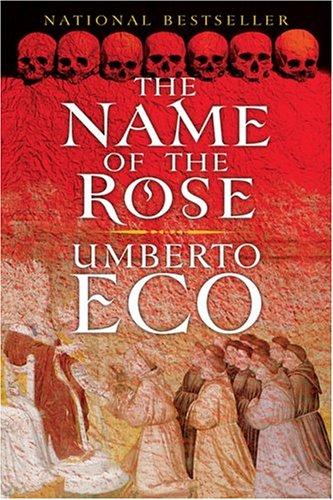
In 1327, the Franciscan friar William of Baskerville arrives at an Italian Benedictine abbey with his novice Adso to attend a theological disputation.
Umberto Eco · 1980 · 12h 0m
Full summary and key takeaways →The 12 questions
- 1.
William's detective method leads to the right conclusion via wrong reasoning. Is Eco mocking empiricism, endorsing it, or doing something more complicated?
- 2.
The forbidden book is Aristotle's Poetics on comedy. Why does Eco choose a defense of laughter as the knowledge that must be suppressed?
- 3.
Jorge of Burgos is the novel's primary villain. Does his logic make sense on its own terms, or is he simply a fanatic?
- 4.
The unnamed peasant girl exists in the novel almost entirely as Adso's projection. Is that a flaw in the novel or a deliberate statement about how women were treated in the medieval world?
- 5.
The Latin is left untranslated. Did you read with a translation open, skip it, or find it didn't matter? How does the decision affect the reading experience?
- 6.
Eco has said he spent years trying to poison his reader in the first hundred pages, to ensure only the right readers continued. Did you feel that resistance, and what kept you going?
- 7.
Bernardo Gui is a historical figure Eco uses with some creative liberty. Does his portrayal feel historically fair?
- 8.
The ending destroys the library. Is that a tragedy, a liberation, or both?
- 9.
Adso as an old man cannot fully make sense of his younger self's experiences. How does that retrospective uncertainty affect how you trust the narrative?
- 10.
The novel is in part a homage to the Sherlock Holmes stories, with William as Holmes and Adso as Watson. Where does the parallel enrich the reading and where does it strain?
- 11.
The theological disputes over Franciscan poverty seem arcane. Does Eco make them feel materially consequential, or do they remain background?
- 12.
What does 'the name of the rose' mean? Does Eco provide enough of an answer, or does the title's ambiguity feel evasive?
How to run the discussion
- Pick six to eight, not all of them. An hour of real discussion covers fewer questions than anyone expects, and racing the list is what makes a book club feel like homework.
- Open with what people noticed, not what they concluded. Asking for a verdict first hardens opinions before anyone has heard each other.
- Let the disagreement run. The questions below that split a room are the ones worth the time; the ones everyone answers the same way can be skipped.
- Ask the quiet person a specific question. A direct, narrow question is far easier to answer than an open invitation to contribute.
Themes worth steering toward
If the conversation stalls, these are the threads that usually restart it.
Common questions
What are good book club questions for The Name of the Rose?
Here are 12 book club questions for The Name of the Rose by Umberto Eco, ordered to open easily and end somewhere worth arguing about. The strongest openers ask what each reader noticed rather than what they concluded, and the discussion usually turns on knowledge and its suppression, religious power and heresy, signs, symbols, and interpretation.
How long should a book club discussion of The Name of the Rose last?
Most groups run 60 to 90 minutes of actual discussion. That is roughly six to eight questions, not all of them, so pick the ones that suit your group rather than working down the list in order.
What are the main themes in The Name of the Rose?
Knowledge and its suppression, Religious power and heresy, Signs, symbols, and interpretation, Truth and its limits, Medieval theology and politics. Those are the threads most likely to divide a room, which makes them the useful places to steer a discussion that has gone quiet.
Picking the next one? See books like The Name of the Rose or questions for other book club picks.
