Politics · Book club
The Narrow Corridor: States, Societies, and the Fate of Liberty book club questions
Here are 12 book club questions for The Narrow Corridor: States, Societies, and the Fate of Liberty by Daron Acemoglu and James A. Robinson, ordered to open easily and end somewhere worth arguing about. Copy them, print them, or bring them up one at a time.
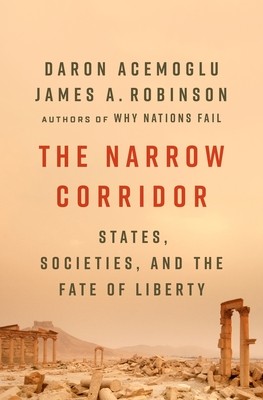
Daron Acemoglu and James Robinson's follow-up to Why Nations Fail shifts focus from prosperity to liberty.
Daron Acemoglu and James A. Robinson · 2019 · 10h 15m
Full summary and key takeaways →The 12 questions
- 1.
The authors say liberty exists in a corridor that requires constant maintenance. Where do you see your own society on that spectrum right now?
- 2.
The Red Queen effect means that state power and societal power have to race together. What happens when one races ahead of the other in practice?
- 3.
They distinguish the Absent Leviathan from the Despotic Leviathan as two different ways to fail. Which failure mode worries you more in your context?
- 4.
Can you think of a country that entered the corridor — moved from despotic or absent toward shackled — in your lifetime? What made it possible?
- 5.
The book argues that norms and habits of civic contestation matter as much as formal institutions. How do you build those, and how do you lose them?
- 6.
Their account of European liberty emphasizes the Reformation, guild structures, and pluralism. Does that suggest liberty is culturally specific rather than universal?
- 7.
How does the Red Queen framing change how you think about democratic backsliding compared to the conventional 'strong institutions' frame?
- 8.
They are skeptical of development strategies that build state capacity without building societal capacity. What would a development program that did both look like?
- 9.
What aspects of civic life in your country would you say are most important for keeping the state in the corridor?
- 10.
The authors are economists and political scientists. Does their framework leave out anything important about the subjective experience of liberty or its limits?
- 11.
Who in contemporary politics do you think best understands the corridor problem, and what does their approach to governing suggest about where they see the state currently?
- 12.
If the corridor is narrow and historically rare, how optimistic should we be about spreading or sustaining liberty globally in the twenty-first century?
How to run the discussion
- Pick six to eight, not all of them. An hour of real discussion covers fewer questions than anyone expects, and racing the list is what makes a book club feel like homework.
- Open with what people noticed, not what they concluded. Asking for a verdict first hardens opinions before anyone has heard each other.
- Let the disagreement run. The questions below that split a room are the ones worth the time; the ones everyone answers the same way can be skipped.
- Ask the quiet person a specific question. A direct, narrow question is far easier to answer than an open invitation to contribute.
Themes worth steering toward
If the conversation stalls, these are the threads that usually restart it.
Common questions
What are good book club questions for The Narrow Corridor: States, Societies, and the Fate of Liberty?
Here are 12 book club questions for The Narrow Corridor: States, Societies, and the Fate of Liberty by Daron Acemoglu and James A. Robinson, ordered to open easily and end somewhere worth arguing about. The strongest openers ask what each reader noticed rather than what they concluded, and the discussion usually turns on liberty, state power, democracy.
How long should a book club discussion of The Narrow Corridor: States, Societies, and the Fate of Liberty last?
Most groups run 60 to 90 minutes of actual discussion. That is roughly six to eight questions, not all of them, so pick the ones that suit your group rather than working down the list in order.
What are the main themes in The Narrow Corridor: States, Societies, and the Fate of Liberty?
Liberty, State power, Democracy, Political institutions, Civil society. Those are the threads most likely to divide a room, which makes them the useful places to steer a discussion that has gone quiet.
Picking the next one? See books like The Narrow Corridor: States, Societies, and the Fate of Liberty or questions for other book club picks.
