Talk to The Network State like its author wrote you back.
Get the ideas that fit your life — not generic summaries.
- Chat with the book
- Audiobook-style main ideas
- Adapts to your life and goals
- Helps you take action
The Network State, in detail
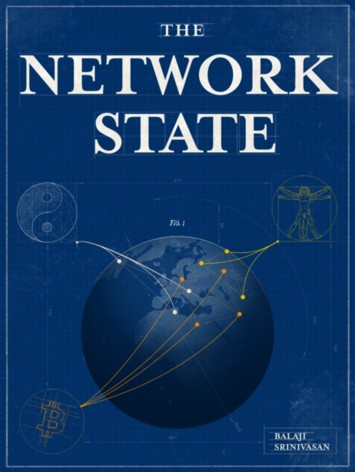
The Network State is Balaji Srinivasan's manifesto for a new kind of political entity: a community that begins as an online network with shared values, grows into a physical presence distributed across multiple countries, and eventually accumulates enough land, population, and international recognition to be treated as a state. Srinivasan — former Andreessen Horowitz partner and CEO of Coinbase — argues that the nation-state is in structural decline and that the 21st century will see new political formations built more like startups than like traditional governments.
The argument begins with a reading of history: that there have been three main sources of legitimacy in political life — the church, the state, and the network — and that the internet has given the third unprecedented organizational power. Srinivasan draws a distinction between what he calls NYT-legibility (the kind of legitimacy that comes from being acknowledged by existing institutions) and blockchain-legibility (legibility enforced by cryptographic proof). His thesis is that the latter is becoming a viable alternative to the former, and that communities with strong internal consensus can increasingly operate independently of legacy validation.
The book's most concrete section describes how a network state would actually form: start with a digital community around a shared moral innovation (a specific value proposition distinguishing it from existing societies), build a social network, create a shared economy using cryptocurrency, establish trust through reputation and on-chain history, and then acquire physical real estate in multiple small parcels around the world before eventually seeking diplomatic recognition from existing states. Srinivasan uses various historical examples — the Mormon settlement of Utah, the Zionist project, the floating islands of Seasteading — as analogies.
The book is long, digressive, and written in a voice that blends academic framework-building with the high-confidence tone of a venture pitch. Critics note that the network state concept sidesteps the hardest political questions about coercion, exit rights for dissenters, and what happens when a community's consensus changes. Proponents argue that the framework is genuinely new and that the objections apply equally to existing states. The Network State is best read as an extended thought experiment with serious implications for anyone thinking about technology, governance, and the next generation of political institutions.
The big ideas
- 1.
The nation-state is not the permanent form of political organization. It emerged in a specific historical context and could be succeeded by forms better suited to a networked, global population.
- 2.
A network state begins as an online community with a shared moral innovation — a specific, distinctive value — that distinguishes it from default society and gives members a reason to self-organize.
- 3.
Cryptographic proof enables a new kind of institutional legitimacy that doesn't depend on recognition by existing governments, media, or institutions.
