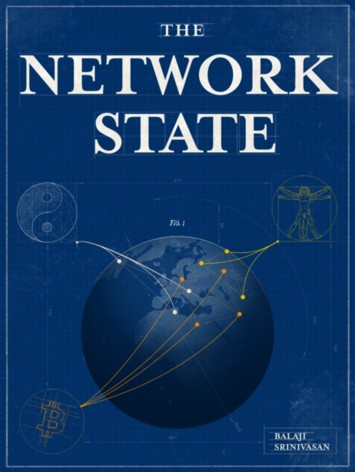
The Network State by Balaji Srinivasan is a 2022 politics book about startup cities, political innovation, decentralization. The nation-state is not the permanent form of political organization. It emerged in a specific historical context and could be succeeded by forms better suited to a networked, global population.
Summary
The Network State is Balaji Srinivasan's manifesto for a new kind of political entity: a community that begins as an online network with shared values, grows into a physical presence distributed across multiple countries, and eventually accumulates enough land, population, and international recognition to be treated as a state. Srinivasan — former Andreessen Horowitz partner and CEO of Coinbase — argues that the nation-state is in structural decline and that the 21st century will see new political formations built more like startups than like traditional governments.
The argument begins with a reading of history: that there have been three main sources of legitimacy in political life — the church, the state, and the network — and that the internet has given the third unprecedented organizational power. Srinivasan draws a distinction between what he calls NYT-legibility (the kind of legitimacy that comes from being acknowledged by existing institutions) and blockchain-legibility (legibility enforced by cryptographic proof). His thesis is that the latter is becoming a viable alternative to the former, and that communities with strong internal consensus can increasingly operate independently of legacy validation.
The book's most concrete section describes how a network state would actually form: start with a digital community around a shared moral innovation (a specific value proposition distinguishing it from existing societies), build a social network, create a shared economy using cryptocurrency, establish trust through reputation and on-chain history, and then acquire physical real estate in multiple small parcels around the world before eventually seeking diplomatic recognition from existing states. Srinivasan uses various historical examples — the Mormon settlement of Utah, the Zionist project, the floating islands of Seasteading — as analogies.
The book is long, digressive, and written in a voice that blends academic framework-building with the high-confidence tone of a venture pitch. Critics note that the network state concept sidesteps the hardest political questions about coercion, exit rights for dissenters, and what happens when a community's consensus changes. Proponents argue that the framework is genuinely new and that the objections apply equally to existing states. The Network State is best read as an extended thought experiment with serious implications for anyone thinking about technology, governance, and the next generation of political institutions.
Talk to The Network State like its author wrote you back.
Get the ideas that fit your life — not generic summaries.
- Chat with the book
- Audiobook-style main ideas
- Adapts to your life and goals
- Helps you take action
Key takeaways
- 1.
The nation-state is not the permanent form of political organization. It emerged in a specific historical context and could be succeeded by forms better suited to a networked, global population.
- 2.
A network state begins as an online community with a shared moral innovation — a specific, distinctive value — that distinguishes it from default society and gives members a reason to self-organize.
- 3.
Cryptographic proof enables a new kind of institutional legitimacy that doesn't depend on recognition by existing governments, media, or institutions.
- 4.
The path from community to state runs through: shared values, social network, mutual aid economy, physical real estate, and diplomatic recognition. Each step requires the previous one.
- 5.
Historical parallels — the Mormon migration, the Zionist project, Singapore's founding — show that new political entities can be intentionally constructed when existing institutions fail a constituency.
- 6.
Exit is the network state's alternative to voice. If governance is bad, members leave for a competing state rather than fighting to reform the one they're in.
- 7.
Existing states have a monopoly on the use of legitimate force within their territory, which is the hardest part of network state theory to resolve. Srinivasan's answer — start in permissive jurisdictions, negotiate sovereignty incrementally — is incomplete.
- 8.
The book's definition: a network state is a highly aligned online community with a capacity for collective action that crowdfunds territory around the world and eventually gains diplomatic recognition.
Discussion questions
Use these on your own, with a book club, or as chat starters in Superbook. Book club version, ready to copy or print →
- 1.
Srinivasan argues the nation-state is in structural decline. What evidence do you find most and least convincing in that argument?
- 2.
The network state concept relies heavily on voluntary exit as the mechanism for accountability. What kinds of problems does exit solve that voice doesn't, and vice versa?
- 3.
The book proposes that communities form around a 'moral innovation' — a specific value proposition. Can you think of an existing community that fits that description? What's its moral innovation?
- 4.
Srinivasan distinguishes NYT-legibility from blockchain-legibility. Is that distinction as clean as he presents it, or does cryptographic proof still depend on social consensus at some level?
- 5.
The hardest part of the network state theory is the monopoly on legitimate force. How do you think Srinivasan's framework actually resolves — or fails to resolve — that problem?
- 6.
Historical experiments in intentional political community — Seasteading, intentional communities, charter cities — have mostly failed to scale. What does that record imply about the network state concept?
- 7.
The book is explicitly written from a techno-libertarian perspective that privileges exit over redistribution. What political questions does that framing make it hard to address?
- 8.
Network states would initially rely on the legal systems of host countries for most governance. At what point does that dependency undermine the 'state' claim?
- 9.
Who gets to define the community's founding values, and what recourse does a dissenting minority within a network state have?
- 10.
Srinivasan is optimistic about the ability of online communities to maintain alignment at scale. What historical evidence bears on that optimism?
- 11.
If a network state concept were applied to something you care about — education, healthcare, housing — what would the 'moral innovation' be?
- 12.
The book runs to two hundred thousand words. Does its length reflect intellectual depth or a failure of editorial discipline? What would be lost if it were half as long?
Themes
Frequently asked questions
-
Is The Network State worth reading?
For readers interested in the future of governance, political theory, or the intersection of technology and institutions, yes — it is ambitious and genuinely provocative. It is also long, repetitive, and written by someone with a confident ideological agenda. Reading critically is essential.
-
How long is The Network State?
The full text runs approximately two hundred thousand words, making it a serious time commitment. A condensed version is available on the book's website. Many readers find the first third sufficient to engage with the core argument.
-
What is a network state in one sentence?
A network state is an online community with strong shared values that acquires physical territory distributed across multiple countries and eventually seeks recognition as a sovereign state.
-
Who should read The Network State?
Technology investors, political theorists, founders thinking about DAOs or intentional communities, and anyone who finds the current political order inadequate and wants a concrete — if speculative — alternative framework.
-
What are the main criticisms of the network state concept?
That it ignores the problem of coercive authority (who enforces rules on those who don't want to leave), that it primarily benefits mobile, wealthy, tech-savvy people, and that the historical analogies Srinivasan uses actually had access to state-level coercive power in ways his framework doesn't.
Similar books

Zero to One: Notes on Startups, or How to Build the Future
Peter Thiel
The Sovereign Individual
James Dale Davidson & William Rees-Mogg

Political Order and Political Decay
Francis Fukuyama
Why Nations Fail: The Origins of Power, Prosperity, and Poverty
Daron Acemoglu and James A. Robinson
