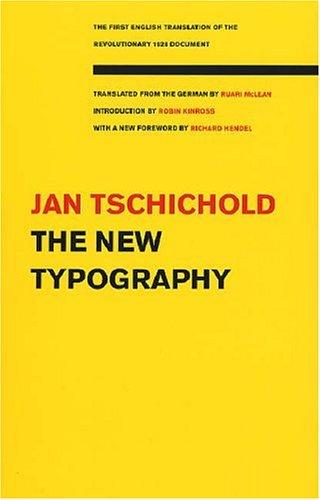
Talk to The New Typography like its author wrote you back.
Get the ideas that fit your life — not generic summaries.
- Chat with the book
- Audiobook-style main ideas
- Adapts to your life and goals
- Helps you take action
What it argues
The New Typography, published in German in 1928 as Die neue Typographie, is Jan Tschichold's manifesto for a modernist approach to printed communication. Written when Tschichold was 26 and deeply influenced by the Bauhaus and constructivism, it argues that typography must abandon historicism — the imitation of Renaissance and Victorian typographic forms — and develop a visual language appropriate to the machine age. The book is simultaneously a polemical argument, a practical handbook, and a historical document that shows what was at stake in the 1920s debate about what design should become.
Tschichold's case is built on a functionalist premise: the purpose of typography is to communicate, and every formal decision should serve that purpose. Centered compositions, decorative ornaments, and symmetrical layouts are condemned not on aesthetic grounds alone but because they slow reading and impose convention over clarity. Asymmetric layout, the use of white space as an active compositional element, and a restricted typeface palette — primarily sans-serif — are presented as more honest and more efficient solutions.
What it gets right
- 1.
Form follows function in typography as in architecture: every decision about typeface, spacing, and layout should serve communication rather than convention or decoration.
- 2.
Asymmetric layout is not arbitrary or avant-garde — it reflects the natural directionality of reading and allows more flexible organization of visual hierarchies than centered or mirrored compositions.
- 3.
The sans-serif typeface became the emblem of modernist typography not because it is objectively better but because it was identified with the machine age and the rejection of historical imitation.
What it covers
Who wrote it
Jan Tschichold (1902–1974) was a German typographer, book designer, and teacher who became one of the most influential figures in twentieth-century graphic design. Born in Leipzig, he published Die neue Typographie at 26 after seeing the Bauhaus exhibition of 1923. He fled Nazi Germany for Switzerland in 1933, and later moved to England to redesign the Penguin Books line. In his later career he became a leading defender of classical typography, repudiating much of his early modernist position. His other works include The Form of the Book, Typographische Gestaltung, and Treasury of Alphabets and Lettering.
