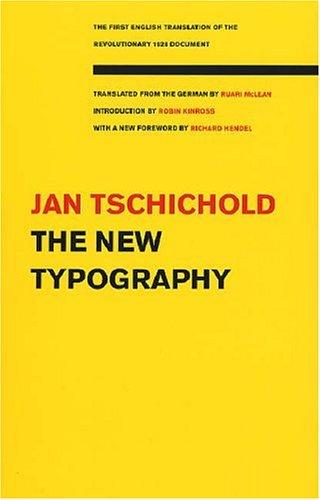
The New Typography by Jan Tschichold is a 1928 philosophy book about typography, modernism, graphic design. Form follows function in typography as in architecture: every decision about typeface, spacing, and layout should serve communication rather than convention or decoration.
Summary
The New Typography, published in German in 1928 as Die neue Typographie, is Jan Tschichold's manifesto for a modernist approach to printed communication. Written when Tschichold was 26 and deeply influenced by the Bauhaus and constructivism, it argues that typography must abandon historicism — the imitation of Renaissance and Victorian typographic forms — and develop a visual language appropriate to the machine age. The book is simultaneously a polemical argument, a practical handbook, and a historical document that shows what was at stake in the 1920s debate about what design should become.
Tschichold's case is built on a functionalist premise: the purpose of typography is to communicate, and every formal decision should serve that purpose. Centered compositions, decorative ornaments, and symmetrical layouts are condemned not on aesthetic grounds alone but because they slow reading and impose convention over clarity. Asymmetric layout, the use of white space as an active compositional element, and a restricted typeface palette — primarily sans-serif — are presented as more honest and more efficient solutions.
The book covers printing technologies, paper standards (it includes an early argument for standardized paper sizes that anticipated DIN and ISO formats), typeface selection, layout for advertisements, business stationery, and book design. Tschichold's approach to each is detailed and prescriptive. He was a practicing typographer and the book shows it: the theoretical chapters are grounded in the realities of letterpress production, not just abstract principle.
The historical irony is that Tschichold later publicly renounced many of the book's positions. By the 1940s he had concluded that his own modernist manifesto was as dogmatic as the historicism it attacked, and he spent the second half of his career as a defender of classical typography — most famously as the redesigner of the Penguin paperback line. That reversal does not diminish the book's historical importance, but it adds an interesting layer of ambivalence to reading it. The New Typography remains essential reading for anyone interested in the origins of graphic design as a discipline and in the ideas that still shape visual communication today.
Talk to The New Typography like its author wrote you back.
Get the ideas that fit your life — not generic summaries.
- Chat with the book
- Audiobook-style main ideas
- Adapts to your life and goals
- Helps you take action
Key takeaways
- 1.
Form follows function in typography as in architecture: every decision about typeface, spacing, and layout should serve communication rather than convention or decoration.
- 2.
Asymmetric layout is not arbitrary or avant-garde — it reflects the natural directionality of reading and allows more flexible organization of visual hierarchies than centered or mirrored compositions.
- 3.
The sans-serif typeface became the emblem of modernist typography not because it is objectively better but because it was identified with the machine age and the rejection of historical imitation.
- 4.
White space is an active compositional element, not empty paper. Tschichold's layouts treat negative space as deliberately as positive form.
- 5.
Standardization of paper sizes has functional advantages Tschichold was among the first to argue for in print — arguments that eventually produced the international paper size standards still in use.
- 6.
Tschichold's later reversal on his own manifesto — his embrace of classical typography — is a useful reminder that modernist design theory was as culturally situated as the historicism it replaced.
- 7.
The New Typography's influence on graphic design education, corporate identity systems, and information design is still directly traceable in contemporary design practice.
Discussion questions
Use these on your own, with a book club, or as chat starters in Superbook. Book club version, ready to copy or print →
- 1.
Tschichold argues that decorative typography imposes convention over clarity. Do you agree? Can ornament and legibility coexist, or is the tradeoff real?
- 2.
The book was written as a manifesto. How does that rhetorical form affect its arguments? What does Tschichold's certainty at 26 tell us about design manifestos generally?
- 3.
Tschichold later renounced much of The New Typography. Does that change how you read it? Is a self-refuted manifesto more or less interesting?
- 4.
The sans-serif typeface became associated with modernism and honesty. Is that association still meaningful, or has it become just another convention?
- 5.
The book argues that typography should serve communication above all. Are there legitimate purposes for typography that have nothing to do with efficiency of reading?
- 6.
How much of contemporary graphic design — websites, apps, publications — still operates under the assumptions Tschichold laid out in 1928?
- 7.
Tschichold was working in letterpress. How does the shift to digital production change which of his arguments still apply?
- 8.
The New Typography was written during the Weimar Republic. Tschichold fled Nazi Germany in 1933 partly because his work was labeled 'cultural Bolshevism.' What does that political context add to reading the book?
- 9.
Which contemporary designers or design systems seem most directly descended from Tschichold's principles? Which most deliberately contradict them?
- 10.
The book is prescriptive in a way that contemporary design education rarely is. Is there value in strong prescriptions in design, or does dogma always eventually cause harm?
- 11.
Tschichold later worked on classical book design and typeface development. How do you reconcile the two phases of his career?
Themes
Frequently asked questions
-
Is The New Typography still relevant to designers today?
Yes, as a historical document and as a set of principles that still underlie much of contemporary design education and practice. The specific prescriptions about sans-serif type and asymmetry have been absorbed into convention; the underlying argument about functional clarity remains live.
-
How long is The New Typography?
The English translation runs to about 250 pages, including historical photographs and Tschichold's own design examples. It is relatively short by design-theory standards and reads quickly, though the historical context repays some prior knowledge.
-
Why did Tschichold abandon the ideas in this book?
He concluded that his own modernism had become as doctrinaire as the historicism he had attacked. By the 1940s he was arguing that classical typefaces and centered layouts had been refined over centuries for good reasons, and that the modernist preference for sans-serif was itself a culturally contingent fashion, not a timeless truth.
-
What is the book's relationship to the Bauhaus?
Tschichold was deeply influenced by the Bauhaus exhibition he saw in 1923, particularly the work of László Moholy-Nagy. He was never a Bauhaus student, but The New Typography synthesizes and extends Bauhaus thinking about typography and applies it to commercial printing practice.
-
Who should read The New Typography?
Graphic designers and typographers seeking to understand where their discipline comes from. Also valuable for anyone interested in modernism, the history of visual culture, or the relationship between design theory and political context.
Similar books
Making and Breaking the Grid
Timothy Samara
Abstract Painting: Concepts and Techniques
Valérie Filiou
A Pattern Language
Christopher Alexander
The Elements of User Experience
Jesse James Garrett
