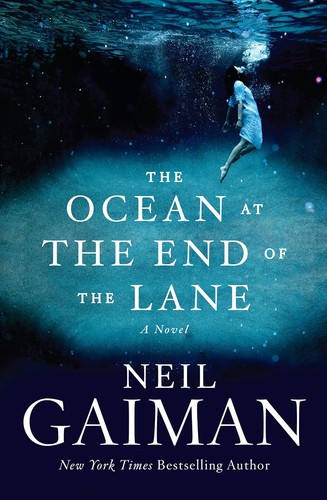
The Ocean at the End of the Lane by Neil Gaiman is a 2013 fantasy book about childhood and memory, fear and powerlessness, sacrifice and protection. The novel maps the subjective experience of childhood terror precisely: the way adult faces shift, the way believing children are not believed, the closed rooms of other people's lives.
Summary
A middle-aged man returns to his childhood village for a funeral and finds himself at the end of a lane he has not visited in decades, at a farm where a girl named Lettie Hempstock once lived. As memory returns, the novel moves backward into his seven-year-old self's terrifying encounter with something that came from outside ordinary life and nearly consumed it. The Ocean at the End of the Lane is both a fairy tale and a novel about what childhood feels like from inside — which is to say, vast and frightening and largely beyond control.
The horror at the novel's center is domestic: a lodger's suicide that opens a hole in the fabric of things, a creature called Ursula who enters through that hole wearing a woman's face and installing herself in the household as a housekeeper. The boy narrator cannot explain to his parents what he knows, cannot be believed when he tries, and must rely on the Hempstock women — Lettie, her mother, her grandmother — who are something older and stranger than they appear. The powerlessness of being seven years old in a situation that adults cannot see is the novel's sharpest register.
Gaiman writes the childhood sections with the specific emotional accuracy that distinguishes his best work — the way adult actions are legible but not explicable to children, the terror of adult faces gone wrong, the particular quality of fear in a house that should be safe. The novel is short and can be read in a sitting, but it doesn't feel slight; the compression is intentional and the mythology at its edge — what the Hempstocks are, what the ocean is — is gestured at rather than explained, which is the right choice.
The Ocean at the End of the Lane is Gaiman's most personal book and also his most controlled. Readers who want epic scope, elaborate world-building, or narrative complexity will find it thin. Readers who want a novel that captures something true about the experience of being small in a world that doesn't explain itself — and about what we forget in order to go on living — will find it quietly devastating.
Talk to The Ocean at the End of the Lane like its author wrote you back.
Get the ideas that fit your life — not generic summaries.
- Chat with the book
- Audiobook-style main ideas
- Adapts to your life and goals
- Helps you take action
Key takeaways
- 1.
The novel maps the subjective experience of childhood terror precisely: the way adult faces shift, the way believing children are not believed, the closed rooms of other people's lives.
- 2.
Forgetting is the novel's most disturbing element — the boy has forgotten this before, will forget again, and the ocean may exist precisely to make this possible.
- 3.
Lettie's sacrifice is presented without explanation or sentimentality; the Hempstocks operate by an older logic than the reader is given access to.
- 4.
The domestic horror — an intrusive presence that adults welcome while the child knows it's wrong — is more effectively frightening than any monster.
- 5.
The novel treats mythology as something that precedes and underlies ordinary life rather than as an escape from it.
- 6.
The frame — a middle-aged man returning to a place he has forgotten — adds a layer of loss that the childhood story alone couldn't carry.
- 7.
Gaiman uses fairy tale logic (three women at the edge of things, an object that cannot be safely held, a cost extracted for protection) without making it feel like pastiche.
- 8.
The ocean is ambiguous by design: it may be a real thing, a metaphor, a symptom of the Hempstocks' nature, or all three. The novel doesn't resolve this, which is correct.
Discussion questions
Use these on your own, with a book club, or as chat starters in Superbook. Book club version, ready to copy or print →
- 1.
The novel hinges on the boy not being believed by his parents when he tells the truth. How did the experience of knowing and being disbelieved register for you as a reader?
- 2.
The Hempstock women are never fully explained. Did you want more explanation, or did the opacity feel right for the kind of story Gaiman is telling?
- 3.
Ursula is frightening partly because she uses her knowledge of what people want against them. How does the novel connect this to adult relationships more broadly?
- 4.
The frame narrative — middle-aged man, funeral, the return — does the work of making the childhood story feel elegiac rather than just scary. Did it succeed?
- 5.
Gaiman has said the novel is personal and draws on his own childhood. Does knowing that change how you read the childhood sections?
- 6.
The boy's father is not a villain — he is simply unable to see what his son sees and makes a terrible choice as a result. How does the novel handle culpability here?
- 7.
What does the ocean actually represent? Did you settle on an interpretation, or did you find the ambiguity generative?
- 8.
The novel's ending depends on the logic of forgetting. Is that a dark ending, a consoling one, or both?
- 9.
The Hempstock grandmother is the oldest thing in the novel, possibly older than the world. How does her presence change the scale of what the boy's experience means?
- 10.
Compared to other fairy-tale-influenced novels — say, Coraline (also Gaiman) or some of Susanna Clarke's work — where does The Ocean at the End of the Lane land in terms of its relationship to horror?
- 11.
The novel is very short for a novel. Did the compression feel right, or did you want more?
- 12.
The boy does not have a name. Did you notice this while reading? Does it matter?
Themes
Frequently asked questions
-
Is The Ocean at the End of the Lane a children's book?
No, though it involves a child protagonist and draws on fairy tale structures. It was published as adult fiction. Some of its content — the domestic horror, the father's betrayal — is too emotionally complex for young readers. Gaiman's Coraline is the more appropriate children's work.
-
How scary is this book?
It is disturbing more than conventionally frightening. The horror is domestic and psychological — an adult face gone wrong, a house that should be safe but isn't — rather than visceral. Some readers find it unsettling in a way that lingers. It is not gratuitously graphic.
-
Is it too short?
At around 180 pages it is one of Gaiman's shortest novels. Most readers find the length exactly right — the compression is structural and the book doesn't overstay. A small number of readers want more of the Hempstock world. The novel doesn't provide that, by design.
-
Is the ending satisfying?
It is quietly devastating and deliberately unresolved in certain ways. Whether that's satisfying depends on what you need from an ending. The emotional logic is complete; the mythological logic remains open.
-
Who shouldn't read it?
Readers who need elaborate world-building, extensive plot, or resolution of all mysteries. Also readers who find child-in-danger horror particularly difficult — the novel's most frightening passages involve an adult threatening a seven-year-old in a domestic setting.