Talk to The Omnivore's Dilemma like its author wrote you back.
Get the ideas that fit your life — not generic summaries.
- Chat with the book
- Audiobook-style main ideas
- Adapts to your life and goals
- Helps you take action
The Omnivore's Dilemma, in detail
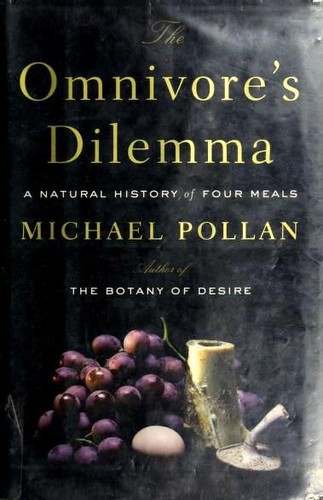
The Omnivore's Dilemma is Michael Pollan's investigation into four food chains — industrial, industrial organic, local pastoral, and hunted-and-gathered — organized around the question of what we should eat. The book's central observation is that humans are generalist eaters capable of eating almost anything, which is both an evolutionary advantage and the source of the dilemma: without fixed instincts dictating our diet, we are perpetually anxious about what to put on our plates, and vulnerable to whatever cultural or commercial forces promise to resolve that anxiety.
The industrial food chain occupies the first third of the book. Pollan traces a McDonald's meal back to its origins in an Iowa cornfield, following the logic of industrial agriculture: how federal corn subsidies created a surplus that had to be disposed of somewhere, leading to corn's insertion into virtually every processed food and to its use as feed for cattle that evolved to eat grass. The result is a food system optimized for calories per dollar but not for nutrition, ecological sustainability, or animal welfare.
The second section turns to organic food and the distance between its ideals and its industrial realization. Pollan visits Whole Foods and then spends a week at Polyface Farm, Joel Salatin's Virginia farm, where pigs, chickens, and cattle rotate across pastures in a system designed to mimic natural ecology rather than maximize monoculture yields. Salatin becomes the book's most vivid character — a farmer who refuses to ship his food, objects to federal oversight, and insists that the soil is the beginning and end of any honest food system.
The final section is a personal experiment: Pollan hunts a wild boar, gathers mushrooms and abalone, and prepares a meal entirely from ingredients he has obtained himself. This is both the most ethical food chain he can construct and the least scalable. The meal is delicious, the experience is profound, and the lesson is modest: most of us cannot live this way, but understanding where food comes from changes how you eat. Throughout, Pollan's argument is that the industrial food chain's opacity — its concealment of the ecological and moral costs of what we eat — is itself a problem, independent of any specific dietary choice.
The big ideas
- 1.
The industrial corn complex underpins the American food system: corn subsidies created surpluses that are now embedded in nearly every processed food and in the feed for most American livestock.
- 2.
Cattle evolved to eat grass but are raised on corn in industrial feedlots because corn makes them fat faster and produces the marbled beef Americans prefer.
- 3.
Industrial organic food largely replicates the industrial model — long supply chains, monocultures, and wage labor — while meeting the letter of organic certification.
