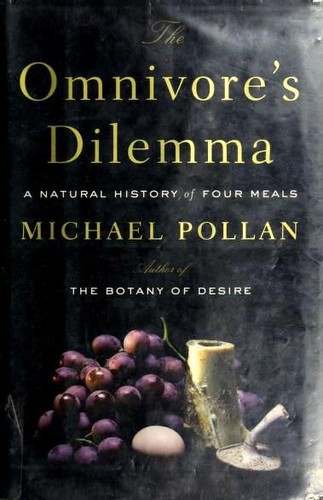
The Omnivore's Dilemma by Michael Pollan is a 2006 health book about food systems, industrial agriculture, ecology. The industrial corn complex underpins the American food system: corn subsidies created surpluses that are now embedded in nearly every processed food and in the feed for most American livestock.
Summary
The Omnivore's Dilemma is Michael Pollan's investigation into four food chains — industrial, industrial organic, local pastoral, and hunted-and-gathered — organized around the question of what we should eat. The book's central observation is that humans are generalist eaters capable of eating almost anything, which is both an evolutionary advantage and the source of the dilemma: without fixed instincts dictating our diet, we are perpetually anxious about what to put on our plates, and vulnerable to whatever cultural or commercial forces promise to resolve that anxiety.
The industrial food chain occupies the first third of the book. Pollan traces a McDonald's meal back to its origins in an Iowa cornfield, following the logic of industrial agriculture: how federal corn subsidies created a surplus that had to be disposed of somewhere, leading to corn's insertion into virtually every processed food and to its use as feed for cattle that evolved to eat grass. The result is a food system optimized for calories per dollar but not for nutrition, ecological sustainability, or animal welfare.
The second section turns to organic food and the distance between its ideals and its industrial realization. Pollan visits Whole Foods and then spends a week at Polyface Farm, Joel Salatin's Virginia farm, where pigs, chickens, and cattle rotate across pastures in a system designed to mimic natural ecology rather than maximize monoculture yields. Salatin becomes the book's most vivid character — a farmer who refuses to ship his food, objects to federal oversight, and insists that the soil is the beginning and end of any honest food system.
The final section is a personal experiment: Pollan hunts a wild boar, gathers mushrooms and abalone, and prepares a meal entirely from ingredients he has obtained himself. This is both the most ethical food chain he can construct and the least scalable. The meal is delicious, the experience is profound, and the lesson is modest: most of us cannot live this way, but understanding where food comes from changes how you eat. Throughout, Pollan's argument is that the industrial food chain's opacity — its concealment of the ecological and moral costs of what we eat — is itself a problem, independent of any specific dietary choice.
Talk to The Omnivore's Dilemma like its author wrote you back.
Get the ideas that fit your life — not generic summaries.
- Chat with the book
- Audiobook-style main ideas
- Adapts to your life and goals
- Helps you take action
Key takeaways
- 1.
The industrial corn complex underpins the American food system: corn subsidies created surpluses that are now embedded in nearly every processed food and in the feed for most American livestock.
- 2.
Cattle evolved to eat grass but are raised on corn in industrial feedlots because corn makes them fat faster and produces the marbled beef Americans prefer.
- 3.
Industrial organic food largely replicates the industrial model — long supply chains, monocultures, and wage labor — while meeting the letter of organic certification.
- 4.
Polyface Farm demonstrates that a farm can be highly productive without chemical inputs by designing systems that mimic ecological relationships — herbivores fertilizing pasture that feeds birds that control insects.
- 5.
The omnivore's dilemma is not just personal; it is cultural. Societies resolve it through food traditions and taboos; modern Americans have largely abandoned both.
- 6.
The true cost of industrial food is externalized: cheap calories are subsidized by environmental degradation, public health costs, and animal suffering that don't appear on the price tag.
- 7.
Hunting and gathering produces the most transparent and ecologically integrated food, but it cannot feed modern populations — its value is experiential and philosophical.
- 8.
Knowing where your food comes from changes how it tastes and how you think about eating. Opacity is a feature of industrial food, not a bug.
Discussion questions
Use these on your own, with a book club, or as chat starters in Superbook. Book club version, ready to copy or print →
- 1.
Pollan argues that cheap food isn't actually cheap once you account for environmental and health externalities. How does that reframe the way you think about grocery prices?
- 2.
Have you ever traced a food you eat regularly back to its origin? What would you find if you did?
- 3.
Joel Salatin refuses to ship his food or scale his farm, arguing that local and transparent food systems are inherently better. Is that a principled position or a luxury available only to wealthy consumers?
- 4.
Pollan is troubled by industrial organic food. Does learning that organic farms can still be large-scale industrial operations change how you feel about buying organic?
- 5.
The book spends significant time on animal welfare in industrial feedlots. How much does the treatment of animals factor into your food choices, and has that changed over time?
- 6.
Pollan hunts a wild boar and describes it as a morally clarifying experience. What would it take for you to be willing to kill an animal you ate? Would that change what you eat?
- 7.
Corn is in almost everything. Does that bother you? Why or why not?
- 8.
If food transparency — knowing exactly how your food was raised and at what cost — were required, how do you think it would change what Americans eat?
- 9.
Pollan identifies three categories of eater: omnivore, herbivore, and carnivore by philosophy. Where do you fall, and is that consistent with what you actually eat?
- 10.
He argues that food traditions are what allow societies to eat without constant anxiety. What food traditions, if any, do you carry from your family or culture?
- 11.
Polyface Farm is compelling but cannot scale. Does the fact that sustainable alternatives can't feed everyone make them irrelevant, or are they valuable for other reasons?
- 12.
After reading this book, is there a food you would stop eating, eat less of, or source differently? What's preventing you from acting on that?
Themes
Frequently asked questions
-
Is The Omnivore's Dilemma worth reading?
Yes, if you want to understand how the American food system actually works rather than how it presents itself. The book is long and detailed, but Pollan is a skilled narrative journalist and the chapters on Polyface Farm and the hunt are genuinely engaging. It will change how you think about what you eat even if it doesn't change what you eat.
-
What is the omnivore's dilemma?
The problem that faces any creature capable of eating a wide variety of foods: how to choose safely among them. For humans, this is complicated by the collapse of food traditions that once resolved the question culturally, leaving us dependent on nutritional science, marketing, and personal anxiety to decide what to eat.
-
How long does it take to read The Omnivore's Dilemma?
Roughly seven to eight hours. At 400 pages it is Pollan's longest and most densely reported book. The first section on industrial corn is the most information-dense; the Polyface Farm section reads more like a profile; the hunting and gathering section is almost personal essay.
-
Is The Omnivore's Dilemma anti-meat?
Not exactly. Pollan eats and defends eating meat, but argues that the conditions under which most American meat is raised are ecologically and morally indefensible. His preferred model is pasture-raised animals integrated into a regenerative farming system like Polyface. He is more opposed to the industrial food system than to meat per se.
-
Who should read The Omnivore's Dilemma?
Anyone curious about where their food comes from and what it costs — financially, ecologically, and ethically. It is particularly useful for people who buy organic and assume they have opted out of industrial agriculture, and for anyone who eats meat and hasn't thought carefully about how it was raised.