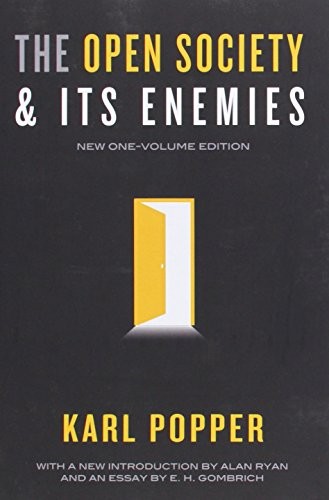
Talk to The Open Society and Its Enemies like its author wrote you back.
Get the ideas that fit your life — not generic summaries.
- Chat with the book
- Audiobook-style main ideas
- Adapts to your life and goals
- Helps you take action
What it argues
Karl Popper wrote The Open Society and Its Enemies during World War II, and the wartime context is inseparable from its argument. Published in 1945, the book is both a philosophical attack on totalitarianism and a defense of liberal democracy grounded in Popper's theory of knowledge. His central claim is that any society claiming to move toward a fixed historical destiny — whether Platonic, Hegelian, or Marxist — will tend toward authoritarianism because it subordinates living individuals to an abstraction. The open society, by contrast, tolerates dissent, corrects its mistakes, and makes no promises about where history is heading.
The book is divided into two volumes. The first targets Plato, arguing that the Republic is not the liberal utopia some admirers believed but a blueprint for a closed, rigid hierarchy in which the philosopher-king rules by deception and citizens are assigned permanent roles. Popper reads Plato's hostility to democracy as an aristocratic reaction to the social disruption of Athens, not a disinterested philosophical conclusion. This reading was immediately controversial and remains so — Plato scholars still argue about how literally the Republic was meant to be taken — but Popper's point is less about Plato's personal intentions than about the template that idealist politics provides.
What it gets right
- 1.
The open society tolerates criticism and corrects its mistakes. The closed society subordinates individuals to a collective destiny and cannot self-correct without violence.
- 2.
Historicism — the belief that history follows discoverable laws pointing toward a fixed goal — is the intellectual foundation of totalitarianism, whether fascist or Marxist.
- 3.
Popper reads Plato's Republic as a totalitarian blueprint: a rigid class hierarchy, philosopher-kings who rule by noble lies, and hostility to change.
What it covers
Who wrote it
Karl Popper (1902–1994) was an Austrian-British philosopher widely regarded as one of the most important thinkers of the twentieth century. Born in Vienna, he fled Austria after the Anschluss and eventually settled in London, where he taught at the London School of Economics. He is best known for his philosophy of science, centered on the principle of falsifiability, developed in The Logic of Scientific Discovery (1934), and for his political philosophy, laid out in The Open Society and its Enemies (1945) and The Poverty of Historicism (1957). His work influenced generations of scientists, economists, and political theorists.
