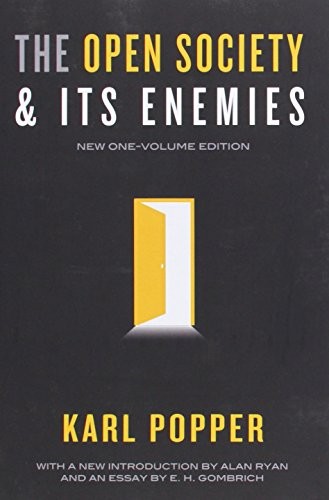
Talk to The Open Society and Its Enemies like its author wrote you back.
Get the ideas that fit your life — not generic summaries.
- Chat with the book
- Audiobook-style main ideas
- Adapts to your life and goals
- Helps you take action
The Open Society and Its Enemies, in detail
Karl Popper wrote The Open Society and Its Enemies during World War II, and the wartime context is inseparable from its argument. Published in 1945, the book is both a philosophical attack on totalitarianism and a defense of liberal democracy grounded in Popper's theory of knowledge. His central claim is that any society claiming to move toward a fixed historical destiny — whether Platonic, Hegelian, or Marxist — will tend toward authoritarianism because it subordinates living individuals to an abstraction. The open society, by contrast, tolerates dissent, corrects its mistakes, and makes no promises about where history is heading.
The book is divided into two volumes. The first targets Plato, arguing that the Republic is not the liberal utopia some admirers believed but a blueprint for a closed, rigid hierarchy in which the philosopher-king rules by deception and citizens are assigned permanent roles. Popper reads Plato's hostility to democracy as an aristocratic reaction to the social disruption of Athens, not a disinterested philosophical conclusion. This reading was immediately controversial and remains so — Plato scholars still argue about how literally the Republic was meant to be taken — but Popper's point is less about Plato's personal intentions than about the template that idealist politics provides.
The second volume trains the same method on Hegel and Marx. Popper coins the term "historicism" for the belief that history follows inexorable laws and that knowing those laws justifies radical action to hasten the outcome. He argues that both Hegel's Prussian statism and Marx's revolutionary socialism are forms of historicism, and that historicist thinking is not just wrong but unfalsifiable — and therefore, in Popper's framework, unscientific. His alternative is "piecemeal social engineering": fixing specific social problems through trial and error rather than pursuing total transformation.
Two features of the book reward close attention. First, Popper's treatment of Marx is more nuanced than his treatment of Hegel; he acknowledges Marx's genuine humanist concerns while arguing the theoretical apparatus undermines them. Second, his defense of the open society is explicitly procedural, not substantive. He is not arguing that liberal democracy produces better outcomes in every case, but that it uniquely allows bad decisions to be reversed without bloodshed. That argument, written as fascism was collapsing and Stalinism was expanding, has aged better than most of its contemporaries.
The big ideas
- 1.
The open society tolerates criticism and corrects its mistakes. The closed society subordinates individuals to a collective destiny and cannot self-correct without violence.
- 2.
Historicism — the belief that history follows discoverable laws pointing toward a fixed goal — is the intellectual foundation of totalitarianism, whether fascist or Marxist.
- 3.
Popper reads Plato's Republic as a totalitarian blueprint: a rigid class hierarchy, philosopher-kings who rule by noble lies, and hostility to change.
