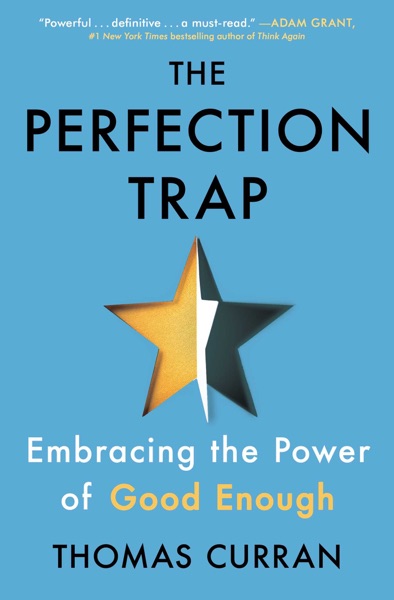
Talk to The Perfection Trap like its author wrote you back.
Get the ideas that fit your life — not generic summaries.
- Chat with the book
- Audiobook-style main ideas
- Adapts to your life and goals
- Helps you take action
What it argues
The Perfection Trap is a social psychologist's case that perfectionism isn't a personality quirk or an asset but a cultural epidemic — and that rates of perfectionism have risen sharply over the past three decades, driven by specific social and economic forces. Thomas Curran, a professor at the London School of Economics who has spent fifteen years studying perfectionism, uses the book to argue that the problem is not individual but structural, and that individual solutions (self-compassion, lowering standards, therapy) are necessary but not sufficient.
Curran distinguishes three types of perfectionism. Self-oriented perfectionism imposes unrealistic standards on oneself. Other-oriented perfectionism imposes them on others. And socially prescribed perfectionism — the most damaging type — is the belief that others expect you to be perfect and will reject you if you're not. All three have risen since the 1980s, but socially prescribed perfectionism has risen fastest, and it's the form most strongly linked to anxiety, depression, eating disorders, and suicidal ideation.
What it gets right
- 1.
Perfectionism has increased significantly over the past three decades, particularly among young people, and rates continue to rise.
- 2.
Socially prescribed perfectionism — the belief that others expect you to be perfect — is the most damaging form and is the type rising fastest.
- 3.
Perfectionism is not the same as high standards. High standards paired with self-compassion for failure produce good outcomes; perfectionism paired with fear of failure produces anxiety and avoidance.
What it covers
Who wrote it
Thomas Curran is a professor of psychology at the London School of Economics and Political Science, where his research focuses on perfectionism, motivation, and well-being. He has published more than sixty peer-reviewed papers and delivered a widely viewed TED Talk on perfectionism's rise. His academic work drawing on large longitudinal datasets documenting rising perfectionism rates has been widely cited in mental health research. The Perfection Trap is his first book for a general audience, translating fifteen years of empirical work into a readable argument about a cultural epidemic.
