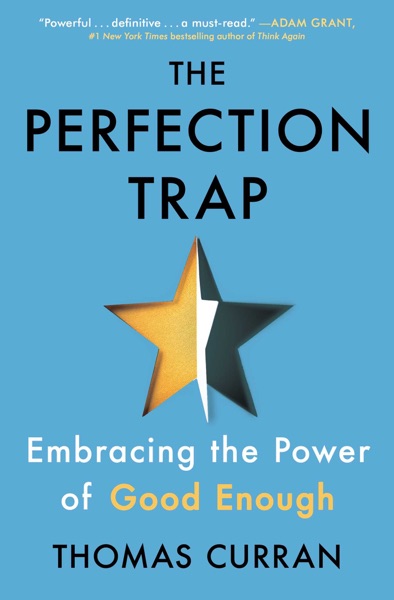
The Perfection Trap by Thomas Curran is a 2023 psychology book about perfectionism, mental health, self-compassion. Perfectionism has increased significantly over the past three decades, particularly among young people, and rates continue to rise.
Summary
The Perfection Trap is a social psychologist's case that perfectionism isn't a personality quirk or an asset but a cultural epidemic — and that rates of perfectionism have risen sharply over the past three decades, driven by specific social and economic forces. Thomas Curran, a professor at the London School of Economics who has spent fifteen years studying perfectionism, uses the book to argue that the problem is not individual but structural, and that individual solutions (self-compassion, lowering standards, therapy) are necessary but not sufficient.
Curran distinguishes three types of perfectionism. Self-oriented perfectionism imposes unrealistic standards on oneself. Other-oriented perfectionism imposes them on others. And socially prescribed perfectionism — the most damaging type — is the belief that others expect you to be perfect and will reject you if you're not. All three have risen since the 1980s, but socially prescribed perfectionism has risen fastest, and it's the form most strongly linked to anxiety, depression, eating disorders, and suicidal ideation.
The driving forces, Curran argues, are neoliberal economic culture — competition, meritocracy, continuous self-improvement as moral duty — combined with social media environments that make comparative evaluation constant and inescapable. The book traces these forces historically, showing how the ideology of individual optimization spread from elite institutions into mass culture. The result is a society in which falling short of an impossible standard is experienced as personal failure rather than as evidence that the standard was wrong.
The book's final section is the most contested. Curran's prescription involves both individual practices (self-compassion, reducing comparative evaluation, therapy) and structural change (limiting the competitive dynamics of schooling, regulating social media, rethinking how organizations measure performance). Critics argue the structural prescriptions are underdeveloped; the book spends more energy diagnosing than solving. But the diagnosis is sharp and evidence-based, and Curran's willingness to locate perfectionism's roots in political economy rather than individual psychology is genuinely distinguishing. For readers whose perfectionism has resisted individual interventions, this book suggests the intervention might need to operate at a different level.
Talk to The Perfection Trap like its author wrote you back.
Get the ideas that fit your life — not generic summaries.
- Chat with the book
- Audiobook-style main ideas
- Adapts to your life and goals
- Helps you take action
Key takeaways
- 1.
Perfectionism has increased significantly over the past three decades, particularly among young people, and rates continue to rise.
- 2.
Socially prescribed perfectionism — the belief that others expect you to be perfect — is the most damaging form and is the type rising fastest.
- 3.
Perfectionism is not the same as high standards. High standards paired with self-compassion for failure produce good outcomes; perfectionism paired with fear of failure produces anxiety and avoidance.
- 4.
The roots of the perfectionism epidemic are cultural and economic: neoliberal meritocracy and competitive individualism have made continuous self-improvement a moral obligation.
- 5.
Social media makes comparative evaluation constant and inescapable, which turbocharges socially prescribed perfectionism in ways that earlier generations didn't face.
- 6.
Perfectionism is strongly associated with anxiety, depression, burnout, eating disorders, and suicidal ideation — it is a serious mental health risk, not a personality strength.
- 7.
Self-compassion — treating yourself with the same understanding you'd offer a friend who failed — is one of the most robust individual-level interventions against perfectionism.
- 8.
Individual solutions are necessary but not sufficient. The conditions producing perfectionism are structural, and personal practices won't solve a societal problem.
Discussion questions
Use these on your own, with a book club, or as chat starters in Superbook. Book club version, ready to copy or print →
- 1.
Curran identifies three types of perfectionism: self-oriented, other-oriented, and socially prescribed. Which type is most present in your own experience?
- 2.
The book argues perfectionism has risen measurably over decades. Do you see that in your own generation compared to people older than you? In younger people you know?
- 3.
Curran's thesis is that the problem is primarily structural — economic and cultural — not individual. If that's true, what follows practically? Does it change how you think about self-improvement books in general?
- 4.
What's the difference in practice between high standards and perfectionism? Have you noticed the distinction in your own work?
- 5.
Social media is presented as a key amplifier of socially prescribed perfectionism. Does that account match your experience of how these platforms affect you?
- 6.
Think of a failure that still bothers you. Is the distress proportionate to the actual consequence, or is it primarily about the gap from an expected standard?
- 7.
Self-compassion is offered as a key intervention. What makes it hard to practice self-compassion rather than self-criticism when you fall short?
- 8.
Curran's structural prescriptions include changing how schools rank students and regulating competitive social environments. Do you find that argument compelling or evasive?
- 9.
Is there a relationship in your life — work, parenting, friendship — where you apply perfectionist standards to others? What's the effect?
- 10.
The book links perfectionism explicitly to rates of anxiety, depression, and eating disorders. Does that clinical framing change how you think about the topic?
- 11.
What would a workplace or school environment look like if it were deliberately designed to reduce socially prescribed perfectionism?
- 12.
Which of Curran's prescriptions — individual practices or structural change — seems more actionable in your life right now?
Themes
Frequently asked questions
-
Is The Perfection Trap worth reading?
Yes, especially for readers who have found individual approaches to perfectionism — self-help, therapy, mindfulness — partially helpful but not fully sufficient. Curran's structural diagnosis explains why individual interventions hit a ceiling.
-
What is the main argument of The Perfection Trap?
That perfectionism is a cultural epidemic driven by neoliberal meritocracy and social media, not primarily a personality problem, and that rates have risen sharply over three decades with serious consequences for mental health.
-
How does this book differ from general self-help on perfectionism?
Most books on perfectionism treat it as an individual pattern to be managed. Curran treats it as a social phenomenon with historical and economic causes. The difference matters because it changes where you look for solutions.
-
Who should read this book?
People who struggle with perfectionism themselves, those who work with young people (parents, teachers, therapists, coaches), and anyone interested in the relationship between economic culture and mental health outcomes.
-
How long is The Perfection Trap?
Around 280 pages, readable in about four to five hours. The early chapters establishing the research are the densest; the later chapters on causes and solutions read faster.
Similar books
The Willpower Instinct
Kelly McGonigal

Mindset: The New Psychology of Success
Carol S. Dweck
Lost Connections
Johann Hari

Four Thousand Weeks: Time Management for Mortals
Oliver Burkeman
