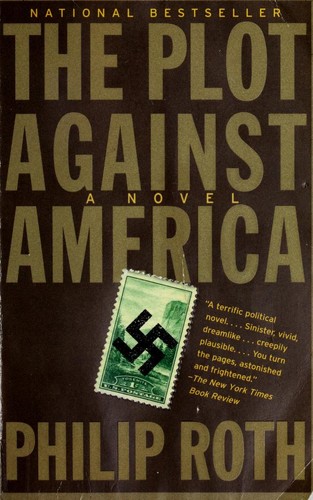
Talk to The Plot Against America like its author wrote you back.
Get the ideas that fit your life — not generic summaries.
- Chat with the book
- Audiobook-style main ideas
- Adapts to your life and goals
- Helps you take action
The Plot Against America, in detail
In Philip Roth's alternate history, Charles Lindbergh defeats Franklin Roosevelt in the 1940 presidential election on an America First platform, negotiates non-aggression agreements with Hitler and Hirohito, and begins a systematic program of quiet antisemitic policy that gradually shifts the conditions of Jewish American life. The Plot Against America is narrated by a young Philip Roth — the Roth family of Newark, New Jersey: father Herman, mother Bess, older brother Sandy, and young Philip, who tells this alternate history from ground level, filtered through the anxious, observant sensibility of a frightened child.
What makes the novel remarkable is Roth's restraint. The horror is mostly slow and administrative rather than violent and spectacular. The Homestead 42 program, which disperses Jewish families into non-Jewish communities in the rural South and Midwest, is the kind of policy that sounds almost reasonable in bureaucratic language and works as social terror in practice. The novel is most interested in what fear does to families: how it splits them along lines of character, who accommodates and who resists, who rationalizes and who maintains clarity. Sandy's drift toward Lindbergh enthusiasm, enabled by an aunt who finds social leverage in collaboration, is a portrait of how ordinary people participate in something they should know is wrong.
The novel was published in 2004 and read as a transparent response to the Bush era, which annoyed some critics who found the allegory too direct. Rereading it after 2016, it acquires different resonances and looks less like allegory and more like clear-eyed political analysis. The Lindbergh of the novel is based on the real Lindbergh's actual political positions in this period, which is both more disturbing and more instructive than pure invention would be. The book is asking how fascism happens in a country that doesn't think of itself as susceptible — by increments, with good reasons offered at each step.
The childhood narration is the novel's best formal choice. Young Philip experiences what the adults are navigating as raw fear and confusion, which gives the historical material an emotional register that third-person political fiction rarely achieves. The book is not Roth's most formally experimental — it's more accessible than American Pastoral or The Human Stain — and readers who know the Zuckerman novels will find it less rich. But as a piece of political imagination it is among the most useful American novels of the last thirty years.
The big ideas
- 1.
Roth shows fascism as an incremental administrative process — the Lindbergh government's antisemitism advances through bureaucratic policy that sounds reasonable at each step and is devastating in aggregate.
- 2.
The child narrator is formally central: young Philip experiences the political crisis as personal fear, which strips away the analytic distance that historical fiction usually provides.
- 3.
Sandy's collaboration arc — the way he drifts toward Lindbergh admiration through social opportunity rather than genuine belief — is one of the novel's most psychologically precise portraits.
