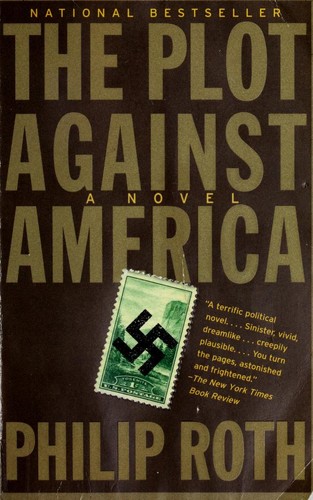
The Plot Against America by Philip Roth is a 2004 historical fiction book about fascism and american democracy, antisemitism, fear and family. Roth shows fascism as an incremental administrative process — the Lindbergh government's antisemitism advances through bureaucratic policy that sounds reasonable at each step and is devastating in aggregate.
Summary
In Philip Roth's alternate history, Charles Lindbergh defeats Franklin Roosevelt in the 1940 presidential election on an America First platform, negotiates non-aggression agreements with Hitler and Hirohito, and begins a systematic program of quiet antisemitic policy that gradually shifts the conditions of Jewish American life. The Plot Against America is narrated by a young Philip Roth — the Roth family of Newark, New Jersey: father Herman, mother Bess, older brother Sandy, and young Philip, who tells this alternate history from ground level, filtered through the anxious, observant sensibility of a frightened child.
What makes the novel remarkable is Roth's restraint. The horror is mostly slow and administrative rather than violent and spectacular. The Homestead 42 program, which disperses Jewish families into non-Jewish communities in the rural South and Midwest, is the kind of policy that sounds almost reasonable in bureaucratic language and works as social terror in practice. The novel is most interested in what fear does to families: how it splits them along lines of character, who accommodates and who resists, who rationalizes and who maintains clarity. Sandy's drift toward Lindbergh enthusiasm, enabled by an aunt who finds social leverage in collaboration, is a portrait of how ordinary people participate in something they should know is wrong.
The novel was published in 2004 and read as a transparent response to the Bush era, which annoyed some critics who found the allegory too direct. Rereading it after 2016, it acquires different resonances and looks less like allegory and more like clear-eyed political analysis. The Lindbergh of the novel is based on the real Lindbergh's actual political positions in this period, which is both more disturbing and more instructive than pure invention would be. The book is asking how fascism happens in a country that doesn't think of itself as susceptible — by increments, with good reasons offered at each step.
The childhood narration is the novel's best formal choice. Young Philip experiences what the adults are navigating as raw fear and confusion, which gives the historical material an emotional register that third-person political fiction rarely achieves. The book is not Roth's most formally experimental — it's more accessible than American Pastoral or The Human Stain — and readers who know the Zuckerman novels will find it less rich. But as a piece of political imagination it is among the most useful American novels of the last thirty years.
Talk to The Plot Against America like its author wrote you back.
Get the ideas that fit your life — not generic summaries.
- Chat with the book
- Audiobook-style main ideas
- Adapts to your life and goals
- Helps you take action
Key takeaways
- 1.
Roth shows fascism as an incremental administrative process — the Lindbergh government's antisemitism advances through bureaucratic policy that sounds reasonable at each step and is devastating in aggregate.
- 2.
The child narrator is formally central: young Philip experiences the political crisis as personal fear, which strips away the analytic distance that historical fiction usually provides.
- 3.
Sandy's collaboration arc — the way he drifts toward Lindbergh admiration through social opportunity rather than genuine belief — is one of the novel's most psychologically precise portraits.
- 4.
Herman Roth's refusal to accommodate is presented not as heroism but as a specific form of character — stubborn, costly, ultimately right — that distinguishes him from his brother and sister-in-law.
- 5.
The novel asks how ordinary American families respond when the political system turns against them — by splitting along lines they didn't know existed.
- 6.
Roth's use of the real Lindbergh's actual political sympathies as the basis for his fictional Lindbergh means the alternate history is closer to documented history than it first appears.
- 7.
The Plot Against America is a novel about the 1940s written in the 2000s and useful in the 2020s, which suggests it is engaging something structural in American democracy rather than a specific historical moment.
- 8.
The ending's return to actual history — Lindbergh's disappearance and the eventual entry into the war — works as relief but also as a reminder that relief is not the same as understanding what happened.
Discussion questions
Use these on your own, with a book club, or as chat starters in Superbook. Book club version, ready to copy or print →
- 1.
Roth uses himself as the child narrator, placing his actual family in a counterfactual history. What does that choice gain — and risk — compared to inventing fictional characters?
- 2.
Sandy's attraction to Lindbergh's movement comes through social opportunity — a summer program, an ambitious aunt — rather than genuine ideology. Does the novel suggest ordinary people participate in bad things that way? Is that a comforting or disturbing conclusion?
- 3.
Herman Roth's stubbornness is both the family's protection and a source of difficulty. Is he the novel's moral center, or is his refusal to accommodate a form of rigidity that the novel critiques?
- 4.
The Homestead 42 program disperses Jewish families into rural America and is presented as benign integration. How does Roth show the difference between the bureaucratic description of a policy and its lived reality?
- 5.
The novel was published in 2004 and read as a Bush allegory. Rereading it after 2016 and 2024, what feels dated about that framing, and what has become more relevant?
- 6.
Lindbergh's actual political history — his America First isolationism, his antisemitic statements — is the basis for the fictional character. How does that grounding in real history change how you read the alternate history?
- 7.
Aunt Evelyn's collaboration is motivated by social aspiration and romantic attachment. Is she a villain in the novel, or is she a figure of something more complicated?
- 8.
The novel's ending returns to actual history — the war, Lindbergh's disappearance — as resolution. Does that ending satisfy you, or does it feel like a cheat?
- 9.
How does the childhood narration shape your experience of the political events? Would the novel work as well from adult Philip's perspective, looking back?
- 10.
The book is about American Jews specifically, but its argument about democratic fragility presumably applies more broadly. Does the specificity strengthen or limit the argument?
- 11.
Compare this to 1984 or Brave New World as a political fiction. What does the domestic, family-centered scale of The Plot Against America do differently?
- 12.
After reading the novel, do you find its vision of American democracy more or less fragile than you did before? Does Roth offer any resources for resistance, or only anatomy of collapse?
- 13.
The novel ends with the Lindbergh nightmare effectively over. Is that a hopeful ending about the resilience of democracy, or does the fragility of the resolution trouble you?
Themes
Frequently asked questions
-
Is The Plot Against America based on real events?
It's an alternate history, but based on real political figures and real politics. Charles Lindbergh's America First isolationism and documented antisemitic sympathies are the historical foundation. The Roth family of Newark is based on Roth's own family. What is invented is the counterfactual: Lindbergh winning the 1940 election and implementing antisemitic policy.
-
Is it hard to read, given the subject matter?
It is emotionally heavy but not gratuitously brutal. The horror is mostly administrative and psychological — the slow suffocation of a family's security — rather than graphic. The child narrator manages the weight carefully. Most readers find it gripping and difficult in equal measure.
-
How does The Plot Against America compare to Roth's other novels?
It's more accessible than the American Trilogy or the Zuckerman novels. The family narrative is straightforward; the alternate history premise is clearly defined. Readers new to Roth often find it a better entry point than American Pastoral, which is formally denser.
-
Was there a TV adaptation?
Yes. HBO produced a miniseries adaptation in 2020, with David Simon and Ed Burns as showrunners. It updates the timeline to the present day, which changes the political resonances. Most readers who love the novel find the adaptation interesting but compromised by the contemporizing.
-
Who shouldn't read The Plot Against America?
Readers who want fast-paced plot and external action will find the novel's slow administrative horror frustrating. Those who find alternate history premises gimmicky should know the book earns its premise. And if you're looking for Roth at his most stylistically ambitious, the Zuckerman novels or American Pastoral are better choices.