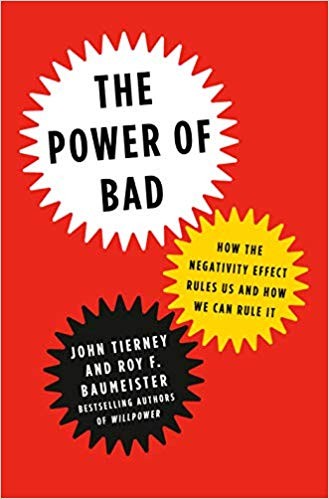
Talk to The Power of Bad: How the Negativity Effect Rules Us and How We Can Rule It like its author wrote you back.
Get the ideas that fit your life — not generic summaries.
- Chat with the book
- Audiobook-style main ideas
- Adapts to your life and goals
- Helps you take action
What it argues
Roy Baumeister is a social psychologist who co-authored the most-cited paper in the field — "Bad Is Stronger Than Good" — and this book is his attempt, with science writer John Tierney, to explain that finding to a general audience and draw out its practical implications. The core claim: bad events, bad feedback, bad emotions, and bad information consistently have more impact than equivalent good ones. A single criticism undoes many compliments. A single loss hurts more than an equivalent gain pleases. The asymmetry is large and pervasive.
The first part of the book documents the negativity effect across multiple domains: relationships, workplaces, politics, the news, and consumer reviews. The research is extensive. In marriages, for instance, Baumeister draws on John Gottman's work showing that relationships stay stable only when positive interactions vastly outnumber negative ones — a ratio of roughly five to one. In news media, the same asymmetry drives what gets covered and what people click. The negativity bias isn't a malfunction; it's an evolutionary adaptation that kept our ancestors from being killed by underestimating threats.
What it gets right
- 1.
Bad is stronger than good: negative events, emotions, feedback, and information have more impact than equivalent positive ones across virtually every domain studied.
- 2.
The negativity effect is evolutionary. It was adaptive to weight threats more heavily than rewards — getting killed once costs more than a missed meal.
- 3.
In close relationships, maintaining a ratio of roughly five positive interactions to one negative is associated with stability. A single serious negative event can require many positive ones to counteract.
What it covers
Who wrote it
Roy F. Baumeister is a professor of psychology at the University of Queensland and one of the most cited social psychologists in the world. His research spans self-control, ego depletion, decision-making, and the psychology of evil. He co-authored the 2001 paper "Bad Is Stronger Than Good," the most cited paper in social psychology. John Tierney is a science writer and former columnist for The New York Times who previously co-wrote Willpower with Baumeister. Together they have written two books bringing Baumeister's decades of research to a general audience.
