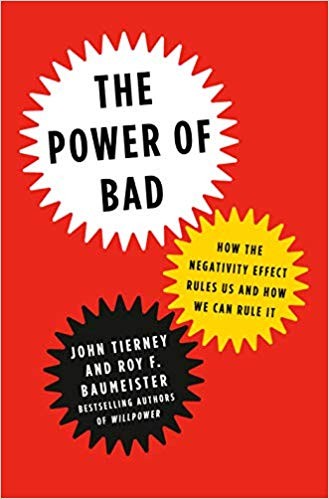
Talk to The Power of Bad: How the Negativity Effect Rules Us and How We Can Rule It like its author wrote you back.
Get the ideas that fit your life — not generic summaries.
- Chat with the book
- Audiobook-style main ideas
- Adapts to your life and goals
- Helps you take action
The Power of Bad: How the Negativity Effect Rules Us and How We Can Rule It, in detail
Roy Baumeister is a social psychologist who co-authored the most-cited paper in the field — "Bad Is Stronger Than Good" — and this book is his attempt, with science writer John Tierney, to explain that finding to a general audience and draw out its practical implications. The core claim: bad events, bad feedback, bad emotions, and bad information consistently have more impact than equivalent good ones. A single criticism undoes many compliments. A single loss hurts more than an equivalent gain pleases. The asymmetry is large and pervasive.
The first part of the book documents the negativity effect across multiple domains: relationships, workplaces, politics, the news, and consumer reviews. The research is extensive. In marriages, for instance, Baumeister draws on John Gottman's work showing that relationships stay stable only when positive interactions vastly outnumber negative ones — a ratio of roughly five to one. In news media, the same asymmetry drives what gets covered and what people click. The negativity bias isn't a malfunction; it's an evolutionary adaptation that kept our ancestors from being killed by underestimating threats.
The more interesting — and more contested — second part of the book addresses what to do about it. Baumeister and Tierney argue that knowing about the bias allows you to apply a kind of corrective accounting to your own emotional reactions, relationships, and decision-making. They advocate for what they call "critical positivity": giving bad feedback its due weight, not dismissing it, but deliberately adding positive context to prevent the bad from drowning out the good. The idea is not forced positivity but structural awareness of an asymmetry.
The book is most convincing on the empirical side and most hand-wavy on the prescriptive side. The advice to "counteract bad with good" is accurate but can feel obvious given the setup. Readers who encounter it as an introduction to negativity bias research will find it a thorough and readable primer. Readers already familiar with the field may find the practical sections thin.
The big ideas
- 1.
Bad is stronger than good: negative events, emotions, feedback, and information have more impact than equivalent positive ones across virtually every domain studied.
- 2.
The negativity effect is evolutionary. It was adaptive to weight threats more heavily than rewards — getting killed once costs more than a missed meal.
- 3.
In close relationships, maintaining a ratio of roughly five positive interactions to one negative is associated with stability. A single serious negative event can require many positive ones to counteract.
