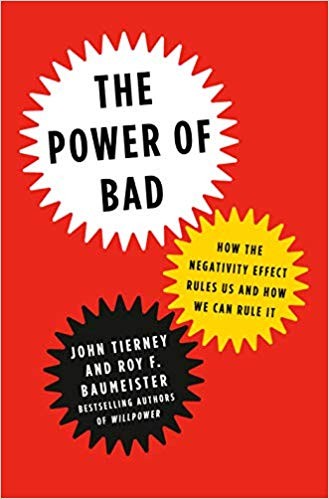
The Power of Bad: How the Negativity Effect Rules Us and How We Can Rule It by John Tierney and Roy F. Baumeister is a 2019 psychology book about negativity bias, cognitive bias, resilience. Bad is stronger than good: negative events, emotions, feedback, and information have more impact than equivalent positive ones across virtually every domain studied.
Summary
Roy Baumeister is a social psychologist who co-authored the most-cited paper in the field — "Bad Is Stronger Than Good" — and this book is his attempt, with science writer John Tierney, to explain that finding to a general audience and draw out its practical implications. The core claim: bad events, bad feedback, bad emotions, and bad information consistently have more impact than equivalent good ones. A single criticism undoes many compliments. A single loss hurts more than an equivalent gain pleases. The asymmetry is large and pervasive.
The first part of the book documents the negativity effect across multiple domains: relationships, workplaces, politics, the news, and consumer reviews. The research is extensive. In marriages, for instance, Baumeister draws on John Gottman's work showing that relationships stay stable only when positive interactions vastly outnumber negative ones — a ratio of roughly five to one. In news media, the same asymmetry drives what gets covered and what people click. The negativity bias isn't a malfunction; it's an evolutionary adaptation that kept our ancestors from being killed by underestimating threats.
The more interesting — and more contested — second part of the book addresses what to do about it. Baumeister and Tierney argue that knowing about the bias allows you to apply a kind of corrective accounting to your own emotional reactions, relationships, and decision-making. They advocate for what they call "critical positivity": giving bad feedback its due weight, not dismissing it, but deliberately adding positive context to prevent the bad from drowning out the good. The idea is not forced positivity but structural awareness of an asymmetry.
The book is most convincing on the empirical side and most hand-wavy on the prescriptive side. The advice to "counteract bad with good" is accurate but can feel obvious given the setup. Readers who encounter it as an introduction to negativity bias research will find it a thorough and readable primer. Readers already familiar with the field may find the practical sections thin.
Talk to The Power of Bad: How the Negativity Effect Rules Us and How We Can Rule It like its author wrote you back.
Get the ideas that fit your life — not generic summaries.
- Chat with the book
- Audiobook-style main ideas
- Adapts to your life and goals
- Helps you take action
Key takeaways
- 1.
Bad is stronger than good: negative events, emotions, feedback, and information have more impact than equivalent positive ones across virtually every domain studied.
- 2.
The negativity effect is evolutionary. It was adaptive to weight threats more heavily than rewards — getting killed once costs more than a missed meal.
- 3.
In close relationships, maintaining a ratio of roughly five positive interactions to one negative is associated with stability. A single serious negative event can require many positive ones to counteract.
- 4.
Criticism lands harder than praise. This asymmetry affects how people receive feedback, and why even mostly positive reviews feel defined by their negative sentences.
- 5.
News and social media are amplified by the negativity bias. Bad news gets clicks; good news rarely achieves the same spread. The information environment we live in is shaped by this asymmetry.
- 6.
Critical positivity doesn't mean ignoring bad information. It means consciously accounting for the asymmetry when assessing situations, relationships, and decisions.
- 7.
The 'four horsemen' of relationship decline Baumeister draws on — contempt, criticism, defensiveness, stonewalling — are each one-sided negatives with outsized destructive power.
- 8.
In performance feedback, sandwiching criticism between praise rarely works as intended. The criticism usually dominates regardless of what surrounds it.
Discussion questions
Use these on your own, with a book club, or as chat starters in Superbook. Book club version, ready to copy or print →
- 1.
Can you identify a relationship or situation in your life where a single bad event has defined your memory of an otherwise positive experience?
- 2.
Baumeister cites the five-to-one ratio for relationship stability. Think about a close relationship. Does this ratio describe what you actually experience?
- 3.
The negativity bias shapes news consumption: bad news spreads faster. How deliberately do you curate your information environment to counteract this?
- 4.
Think of a piece of negative feedback you received that stuck with you disproportionately. Was it accurate? Useful? Why did it carry so much weight?
- 5.
The book argues the negativity bias is an evolutionary adaptation, not a flaw. Does knowing its origin change how you relate to your own negative emotional reactions?
- 6.
Where in your workplace does the negativity effect operate most visibly — in how feedback is given, how decisions are made, or how crises are managed?
- 7.
Tierney and Baumeister suggest 'critical positivity' as a corrective: not fake positivity but structural awareness of the asymmetry. What would this look like in practice in your life?
- 8.
Research shows that consumer reviews are disproportionately influenced by negative ratings. How does this change how you read reviews, or how you write them?
- 9.
The book discusses how bad experiences in childhood tend to be more forming than positive ones. Is that consistent with your experience, or do positive experiences stand out as equally defining?
- 10.
In politics, negative advertising works. How does the negativity effect shape your own political beliefs and what you attend to?
- 11.
If bad feedback is harder to ignore, how do you give feedback to others in a way that's honest without triggering avoidance or defensiveness?
- 12.
What's a domain in your life where you think the negativity bias is currently costing you something — a relationship, a decision, a creative project?
Themes
Frequently asked questions
-
What is The Power of Bad about?
It's a detailed examination of the negativity effect — the well-documented finding that bad events, emotions, feedback, and information have more psychological impact than equivalent positive ones. Baumeister and Tierney survey the research across relationships, workplaces, politics, and media, then offer strategies for counteracting the asymmetry.
-
Is The Power of Bad worth reading?
Yes, if you want a thorough introduction to negativity bias research. The empirical sections are strong and well-sourced. The prescriptive advice in the second half is thinner — accurate but obvious compared to the setup. Worth reading alongside the academic paper 'Bad Is Stronger Than Good.'
-
Who should read The Power of Bad?
Anyone who gives or receives feedback professionally, manages relationships, makes decisions under uncertainty, or thinks about why bad news spreads faster than good. Particularly useful for managers, therapists, educators, and anyone who has been told to 'focus on the positive' without understanding the structural reason that's hard.
-
How is The Power of Bad different from Thinking, Fast and Slow?
Kahneman's book covers cognitive bias broadly across many systems. The Power of Bad is narrower: it focuses specifically on the asymmetry between negative and positive, and is more practically oriented toward relationships and communication rather than decision theory.
-
What's the main practical takeaway?
That correcting for negativity bias requires more than good intentions. In relationships, five positives for every one negative is the structural requirement for stability. In feedback, knowing the criticism will dominate means being deliberate about how much positive context you provide, not as a sandwich but as genuine, frequent acknowledgment.
Similar books
Thinking, Fast and Slow
Daniel Kahneman
You Are Not So Smart
David McRaney
The Optimism Bias: A Tour of the Irrationally Positive Brain
Tali Sharot
Stumbling on Happiness
Daniel Gilbert
