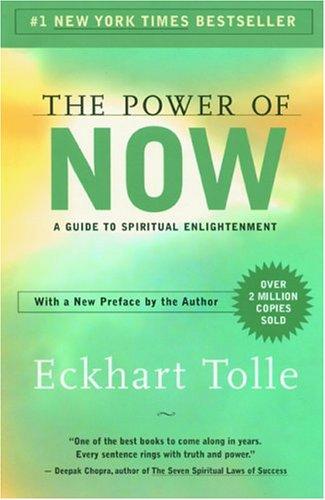
Talk to The Power of Now like its author wrote you back.
Get the ideas that fit your life — not generic summaries.
- Chat with the book
- Audiobook-style main ideas
- Adapts to your life and goals
- Helps you take action
What it argues
The Power of Now is Eckhart Tolle's argument that the root of human suffering is identification with the stream of thought — the restless inner commentary that most people mistake for who they are. Tolle calls this the "ego" or the "pain-body" and argues that nearly all psychological pain comes from resistance to what is, which always means resistance to the present moment. The book's central claim is disarmingly simple: you are not your thoughts. Awareness of thought is itself a different order of consciousness, and that awareness is always here, always now.
Most of the book is structured as a dialogue, with Tolle answering questions about consciousness, time, relationships, and suffering. He distinguishes between clock time — practical planning for the future — and psychological time, the mental habit of living in memory or anticipation rather than in what is actually happening. The ego feeds on time. It defines itself through its story, its problems, its accumulated resentments. Presence dissolves that story not by solving it but by stepping back from identification with it entirely.
What it gets right
- 1.
You are not your thoughts. The thinker and the awareness observing the thinker are not the same thing, and recognizing that gap is the beginning of presence.
- 2.
The ego is a mental structure built from identification with thought, memory, and story. It survives by generating problems and keeping attention in the past or future.
- 3.
Psychological time — living in memory or anticipation — is the source of most human suffering. Clock time, used for practical planning, is fine; psychological time is the problem.
What it covers
Who wrote it
Eckhart Tolle is a German-born spiritual teacher and author based in Vancouver, Canada. Born in 1948, he experienced what he describes as a sudden inner transformation at age twenty-nine — the dissolution of his anxious sense of self — that became the basis for his teaching. The Power of Now was self-published in 1997 and later picked up by New World Library; it went on to sell over 16 million copies after Oprah Winfrey recommended it to her audience in 2000. His follow-up, A New Earth, extends the same themes across relationships and collective consciousness. Tolle leads retreats internationally and is not affiliated with any single religious tradition.
