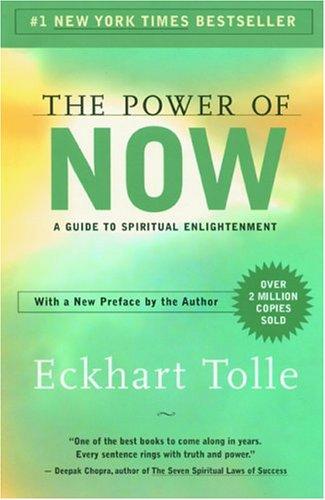
The Power of Now by Eckhart Tolle is a 1997 religion & spirituality book about presence, consciousness, ego. You are not your thoughts. The thinker and the awareness observing the thinker are not the same thing, and recognizing that gap is the beginning of presence.
Summary
The Power of Now is Eckhart Tolle's argument that the root of human suffering is identification with the stream of thought — the restless inner commentary that most people mistake for who they are. Tolle calls this the "ego" or the "pain-body" and argues that nearly all psychological pain comes from resistance to what is, which always means resistance to the present moment. The book's central claim is disarmingly simple: you are not your thoughts. Awareness of thought is itself a different order of consciousness, and that awareness is always here, always now.
Most of the book is structured as a dialogue, with Tolle answering questions about consciousness, time, relationships, and suffering. He distinguishes between clock time — practical planning for the future — and psychological time, the mental habit of living in memory or anticipation rather than in what is actually happening. The ego feeds on time. It defines itself through its story, its problems, its accumulated resentments. Presence dissolves that story not by solving it but by stepping back from identification with it entirely.
Tolle is working in a tradition that includes Zen Buddhism, Advaita Vedanta, and Christian mysticism, but he strips the language of sectarian packaging. Readers from any background or none can follow the core argument without signing on to a cosmology. That said, the book does make metaphysical claims about consciousness and the nature of being that are not provable and that some readers will find either self-evident or entirely unevidenced, depending on their prior commitments.
The Power of Now is less a how-to book than a pointer. It doesn't give you a technique as much as it invites a shift in where you're looking. For readers who encounter it at the right moment, it can be genuinely disorienting in a useful way. For readers who prefer concrete practices, the companion Practicing the Power of Now offers more structured entry points. The prose can feel circular — the Q&A format returns to the same core insight from many angles — but that repetition is partly the point: Tolle is not trying to add to your knowledge, he is trying to get you to notice what is already present.
Talk to The Power of Now like its author wrote you back.
Get the ideas that fit your life — not generic summaries.
- Chat with the book
- Audiobook-style main ideas
- Adapts to your life and goals
- Helps you take action
Key takeaways
- 1.
You are not your thoughts. The thinker and the awareness observing the thinker are not the same thing, and recognizing that gap is the beginning of presence.
- 2.
The ego is a mental structure built from identification with thought, memory, and story. It survives by generating problems and keeping attention in the past or future.
- 3.
Psychological time — living in memory or anticipation — is the source of most human suffering. Clock time, used for practical planning, is fine; psychological time is the problem.
- 4.
The pain-body is an accumulation of old emotional pain that feeds on negative thinking and conflict. Awareness of it, without identification, weakens its hold.
- 5.
Presence is not a state you achieve; it is what remains when you stop compulsively thinking. It is already here — it only requires noticing.
- 6.
Resistance to the present moment is the same thing as resistance to what is. Acceptance doesn't mean passivity; it means acting from clarity rather than from reactivity.
- 7.
Relationships amplify unconsciousness. Two egos in proximity generate friction automatically. Presence in relationship means responding to what is actually happening rather than to the story your mind tells about it.
- 8.
The inner body — attending to physical sensation from the inside — is one of the most reliable anchors to the present moment. Thought pulls away from the now; felt sensation is always now.
Discussion questions
Use these on your own, with a book club, or as chat starters in Superbook. Book club version, ready to copy or print →
- 1.
Tolle says most people are not present most of the time. How much of your day do you spend replaying the past or rehearsing the future, rather than in what is actually happening?
- 2.
Can you locate the gap between a thought arising and your awareness of it? What does that gap feel like when you find it?
- 3.
Tolle distinguishes psychological time from clock time. Where in your life are you using psychological time when clock time would be enough?
- 4.
The pain-body is the accumulated emotional residue that feeds on conflict and negativity. Do you recognize anything like this in yourself? What tends to trigger it?
- 5.
Tolle argues that problems require time to survive — they can't exist in the present moment. Is there a current problem in your life that might dissolve if you looked at it only in the now?
- 6.
What is your relationship to silence and stillness? Does it feel restful or uncomfortable, and what does that tell you?
- 7.
The book claims the ego needs to be right, needs to complain, needs to suffer. Which of those does yours reach for most readily?
- 8.
Tolle says acceptance is not passive resignation. How do you distinguish between genuine acceptance and giving up on something that genuinely needs to change?
- 9.
Have you had an experience of presence — a moment when thought dropped away and the situation was simply vivid and clear? What were the conditions?
- 10.
The book is deliberately repetitive, circling the same insight from many angles. Did that feel clarifying or frustrating to you, and why?
- 11.
Tolle draws on Buddhist, Hindu, and Christian mystic traditions without committing to any of them. Does that feel like intellectual honesty or evasion to you?
- 12.
If the quality of your attention is the quality of your life, as Tolle suggests, what are you actually paying attention to most of the time?
Themes
Frequently asked questions
-
What is The Power of Now about?
It argues that psychological suffering comes from compulsive identification with thought — living in mental replays of the past or projections of the future rather than in what is actually happening now. The book is structured as a dialogue in which Tolle explains how to recognize and step back from that identification.
-
Is The Power of Now worth reading?
For readers who are drawn to questions about consciousness and suffering, yes. It introduces a perspective that is genuinely different from most self-help books, and for some readers it lands as a significant shift. For readers who want a structured practice or empirical grounding, it can feel frustratingly abstract.
-
How long does it take to read The Power of Now?
Around four hours at average reading pace. The chapters are short and the writing is accessible, but many readers slow down to test the ideas against their own experience as they go. It rewards re-reading more than most books in this genre.
-
Do you have to be spiritual or religious to get something from it?
No. Tolle explicitly avoids committing to any tradition's cosmology. The core observations about thought, attention, and suffering are framed in everyday language and don't require belief in anything specific. Readers with a secular background can engage with them as phenomenological observations rather than metaphysical claims.
-
Who shouldn't read The Power of Now?
Readers who want concrete techniques, data-backed claims, or a structured program will likely find it too abstract. The book circles the same insight repeatedly, which some readers experience as depth and others as padding. If you prefer authors like James Clear or Cal Newport, the register is very different here.