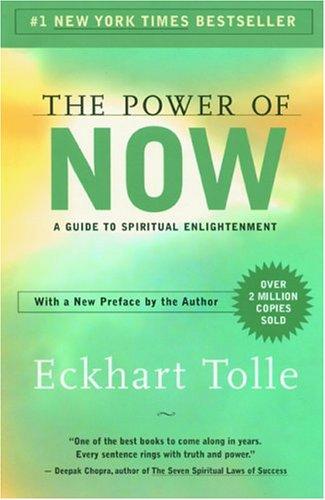
Talk to The Power of Now like its author wrote you back.
Get the ideas that fit your life — not generic summaries.
- Chat with the book
- Audiobook-style main ideas
- Adapts to your life and goals
- Helps you take action
The Power of Now, in detail
The Power of Now is Eckhart Tolle's argument that the root of human suffering is identification with the stream of thought — the restless inner commentary that most people mistake for who they are. Tolle calls this the "ego" or the "pain-body" and argues that nearly all psychological pain comes from resistance to what is, which always means resistance to the present moment. The book's central claim is disarmingly simple: you are not your thoughts. Awareness of thought is itself a different order of consciousness, and that awareness is always here, always now.
Most of the book is structured as a dialogue, with Tolle answering questions about consciousness, time, relationships, and suffering. He distinguishes between clock time — practical planning for the future — and psychological time, the mental habit of living in memory or anticipation rather than in what is actually happening. The ego feeds on time. It defines itself through its story, its problems, its accumulated resentments. Presence dissolves that story not by solving it but by stepping back from identification with it entirely.
Tolle is working in a tradition that includes Zen Buddhism, Advaita Vedanta, and Christian mysticism, but he strips the language of sectarian packaging. Readers from any background or none can follow the core argument without signing on to a cosmology. That said, the book does make metaphysical claims about consciousness and the nature of being that are not provable and that some readers will find either self-evident or entirely unevidenced, depending on their prior commitments.
The Power of Now is less a how-to book than a pointer. It doesn't give you a technique as much as it invites a shift in where you're looking. For readers who encounter it at the right moment, it can be genuinely disorienting in a useful way. For readers who prefer concrete practices, the companion Practicing the Power of Now offers more structured entry points. The prose can feel circular — the Q&A format returns to the same core insight from many angles — but that repetition is partly the point: Tolle is not trying to add to your knowledge, he is trying to get you to notice what is already present.
The big ideas
- 1.
You are not your thoughts. The thinker and the awareness observing the thinker are not the same thing, and recognizing that gap is the beginning of presence.
- 2.
The ego is a mental structure built from identification with thought, memory, and story. It survives by generating problems and keeping attention in the past or future.
- 3.
Psychological time — living in memory or anticipation — is the source of most human suffering. Clock time, used for practical planning, is fine; psychological time is the problem.
