Self-help · Book club
The Power of TED book club questions
Here are 12 book club questions for The Power of TED by David Emerald, ordered to open easily and end somewhere worth arguing about. Copy them, print them, or bring them up one at a time.
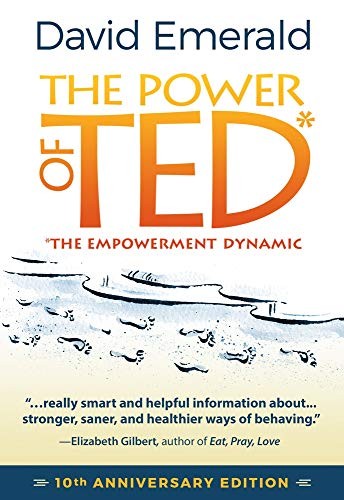
The Power of TED (The Empowerment Dynamic) is David Emerald's fable-based framework for escaping what psychologist Stephen Karpman called the Drama Triangle.
David Emerald · 2005 · 3h 0m
Full summary and key takeaways →The 12 questions
- 1.
Which role in the Drama Triangle — Victim, Persecutor, or Rescuer — do you most often default to? What triggers that shift for you?
- 2.
Emerald argues that even Rescuers are disempowering. Can you think of a relationship where helping someone has actually kept them stuck?
- 3.
What is one situation in your life right now where you are oriented toward fear or away-from rather than toward something you want?
- 4.
How would the way you talk about a current problem change if you described it as a Creator rather than a Victim?
- 5.
Think of someone in your life who functions as a Challenger in Emerald's sense — someone whose accountability has prompted your growth. How do they do it?
- 6.
The book claims that small, imperfect steps toward an outcome matter more than waiting for the right moment. Where are you waiting when you could be moving?
- 7.
How does the Victim-Creator distinction apply to your organization or team? Where do you notice Drama Triangle dynamics at work?
- 8.
Emerald's Challenger role depends on caring about the other person's growth. How does that differ from how accountability is practiced in your workplace?
- 9.
Which is harder for you: shifting from Rescuer to Coach, or from Victim to Creator? Why?
- 10.
Has a Persecutor in your life ever functioned as a growth catalyst? What would it take to reframe them as a Challenger without excusing harmful behavior?
- 11.
The fable format makes the ideas easy to absorb but light on evidence. Did that affect how seriously you took the framework? Why or why not?
- 12.
If you coached yourself the way Emerald's Coach character coaches David, what question would you most need to sit with right now?
How to run the discussion
- Pick six to eight, not all of them. An hour of real discussion covers fewer questions than anyone expects, and racing the list is what makes a book club feel like homework.
- Open with what people noticed, not what they concluded. Asking for a verdict first hardens opinions before anyone has heard each other.
- Let the disagreement run. The questions below that split a room are the ones worth the time; the ones everyone answers the same way can be skipped.
- Ask the quiet person a specific question. A direct, narrow question is far easier to answer than an open invitation to contribute.
Themes worth steering toward
If the conversation stalls, these are the threads that usually restart it.
Common questions
What are good book club questions for The Power of TED?
Here are 12 book club questions for The Power of TED by David Emerald, ordered to open easily and end somewhere worth arguing about. The strongest openers ask what each reader noticed rather than what they concluded, and the discussion usually turns on empowerment, leadership, victim mindset.
How long should a book club discussion of The Power of TED last?
Most groups run 60 to 90 minutes of actual discussion. That is roughly six to eight questions, not all of them, so pick the ones that suit your group rather than working down the list in order.
What are the main themes in The Power of TED?
Empowerment, Leadership, Victim mindset, Relationships, Personal growth. Those are the threads most likely to divide a room, which makes them the useful places to steer a discussion that has gone quiet.
Picking the next one? See books like The Power of TED or questions for other book club picks.
