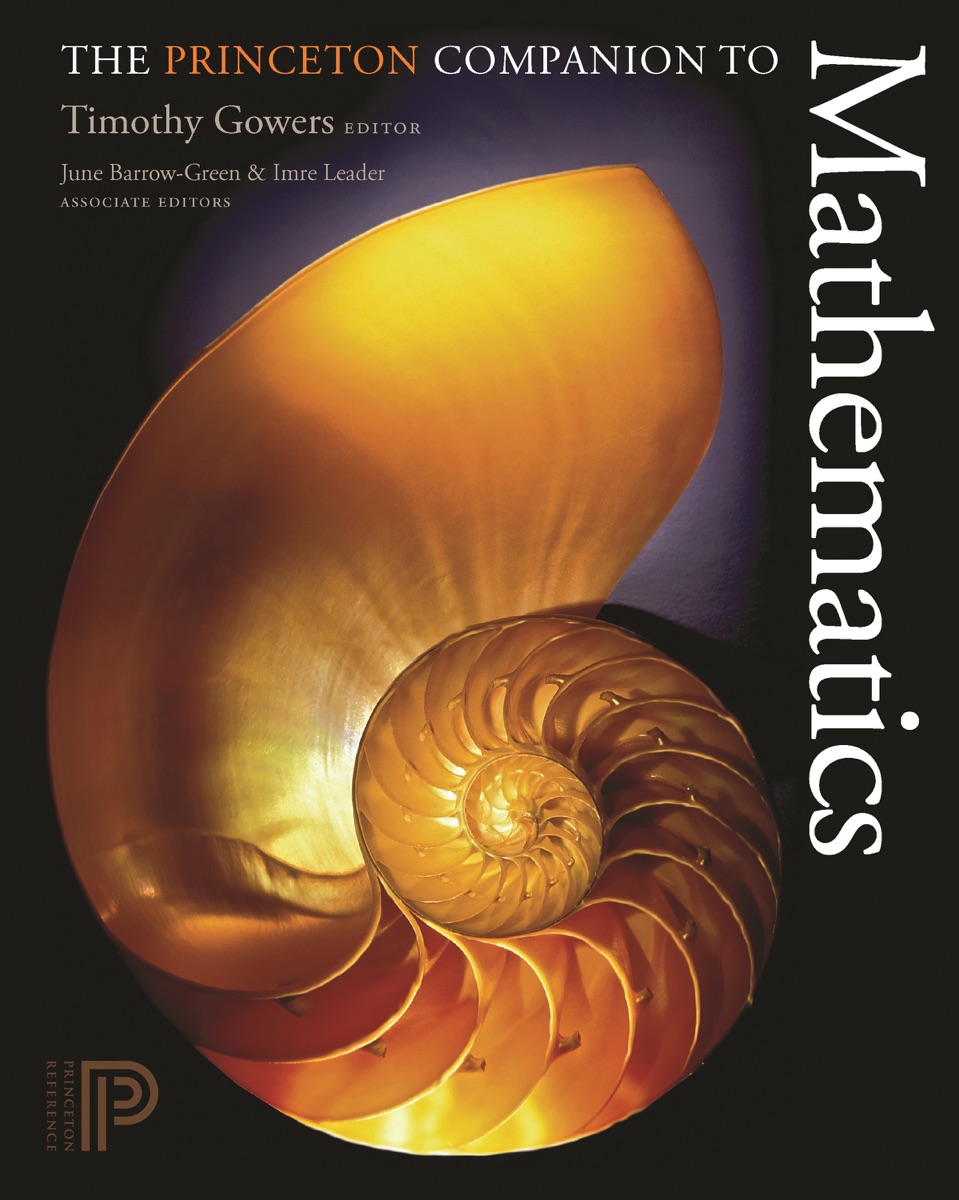
Talk to The Princeton Companion to Mathematics like its author wrote you back.
Get the ideas that fit your life — not generic summaries.
- Chat with the book
- Audiobook-style main ideas
- Adapts to your life and goals
- Helps you take action
What it argues
The Princeton Companion to Mathematics is a reference work unlike most reference works: it is meant to be read, not just consulted. Edited by Fields Medalist Timothy Gowers with contributions from dozens of leading mathematicians, it covers the breadth of modern mathematics in a way that assumes a serious reader — someone comfortable with university-level calculus and proof — but does not require expertise in any specific area. It is a book for mathematicians who want to understand the parts of the field they don't work in, and for educated non-specialists who want to understand what modern mathematics actually is.
The book is organized in sections. The early parts cover the language and foundations of mathematics: what proofs are, how mathematical objects like numbers, sets, and functions are defined, and what it means for something to be true in mathematics. These sections are particularly valuable for readers whose training emphasized computation over reasoning — they explain why mathematicians care about rigor and what the alternative would look like. The historical essays that trace how mathematical ideas developed over centuries are among the most readable pieces in the volume.
What it gets right
- 1.
Modern mathematics is far more than calculation — it is the study of abstract structures and the logical relationships between them, using proof as the primary instrument of knowledge.
- 2.
A mathematical proof is not just a verification that something is true; it is an explanation of why it must be true, which is a deeper and more demanding standard.
- 3.
The major branches of mathematics — algebra, analysis, geometry, topology, number theory — are deeply interconnected, and the most powerful results often arise at their intersections.
What it covers
Who wrote it
Timothy Gowers is a British mathematician and Fields Medalist (1998) who holds the Rouse Ball Professorship at the University of Cambridge. His own research spans combinatorics and functional analysis, but he is also known for his exceptional ability to explain mathematics to non-specialists, which makes him an unusual choice as editor of a reference work aimed at serious general readers. He has written widely on the culture and practice of mathematics. The Princeton Companion to Mathematics, published in 2008, reflects his conviction that mathematical ideas can be communicated clearly without sacrificing accuracy.
