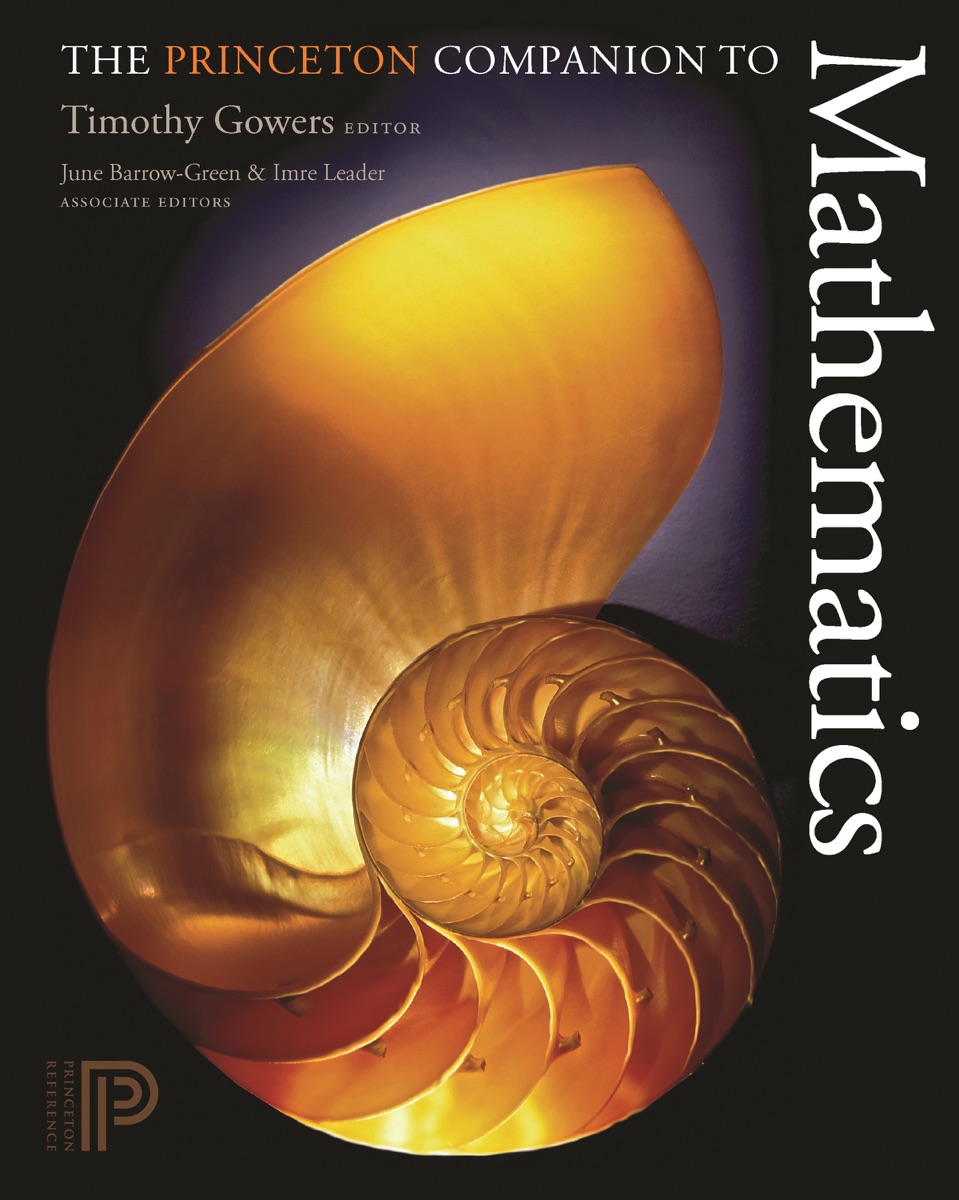
The Princeton Companion to Mathematics by Timothy Gowers is a 2008 science book about mathematics, proofs, mathematical concepts. Modern mathematics is far more than calculation — it is the study of abstract structures and the logical relationships between them, using proof as the primary instrument of knowledge.
Summary
The Princeton Companion to Mathematics is a reference work unlike most reference works: it is meant to be read, not just consulted. Edited by Fields Medalist Timothy Gowers with contributions from dozens of leading mathematicians, it covers the breadth of modern mathematics in a way that assumes a serious reader — someone comfortable with university-level calculus and proof — but does not require expertise in any specific area. It is a book for mathematicians who want to understand the parts of the field they don't work in, and for educated non-specialists who want to understand what modern mathematics actually is.
The book is organized in sections. The early parts cover the language and foundations of mathematics: what proofs are, how mathematical objects like numbers, sets, and functions are defined, and what it means for something to be true in mathematics. These sections are particularly valuable for readers whose training emphasized computation over reasoning — they explain why mathematicians care about rigor and what the alternative would look like. The historical essays that trace how mathematical ideas developed over centuries are among the most readable pieces in the volume.
The core of the book is a series of essays on mathematical concepts and their connections — covering branches like algebraic geometry, number theory, topology, analysis, combinatorics, and probability — written by specialists trying to convey the essential flavor of their area to intelligent outsiders. The quality is uneven, as it must be in a multi-author work, but the best essays are genuinely illuminating. They show not just what a field studies but why its questions matter and what makes its methods interesting.
This is not a book to read cover to cover, though some readers do. It is a book to dip into, to read around a topic you've encountered elsewhere, and to return to when a concept in another book or paper demands more context. The companion functions best as a guide to the landscape of mathematics rather than a complete map of any territory. For anyone serious about understanding what mathematics has become in the last two centuries, there is no comparable single volume.
Talk to The Princeton Companion to Mathematics like its author wrote you back.
Get the ideas that fit your life — not generic summaries.
- Chat with the book
- Audiobook-style main ideas
- Adapts to your life and goals
- Helps you take action
Key takeaways
- 1.
Modern mathematics is far more than calculation — it is the study of abstract structures and the logical relationships between them, using proof as the primary instrument of knowledge.
- 2.
A mathematical proof is not just a verification that something is true; it is an explanation of why it must be true, which is a deeper and more demanding standard.
- 3.
The major branches of mathematics — algebra, analysis, geometry, topology, number theory — are deeply interconnected, and the most powerful results often arise at their intersections.
- 4.
Mathematics has a history of seemingly useless abstract results becoming essential to physics and engineering decades or centuries later. Pure mathematics and applied mathematics are not cleanly separable.
- 5.
The Langlands Program — a set of deep conjectured connections between number theory and analysis — represents one of the great unifying visions in contemporary mathematics.
- 6.
Mathematical intuition, the sense that something should be true before a proof exists, is a real and important faculty, but it is also frequently wrong and must be disciplined by proof.
- 7.
The book demonstrates that mathematical writing at its best is not dense and inaccessible but clear, precise, and motivated — qualities that require skill to achieve.
Discussion questions
Use these on your own, with a book club, or as chat starters in Superbook. Book club version, ready to copy or print →
- 1.
The companion argues that proof-based mathematics is fundamentally different from calculation. Did your own mathematical education emphasize proof or computation, and what did you gain or miss from that emphasis?
- 2.
Several essays describe results that were developed in pure abstraction and later turned out to be essential to physics or cryptography. What does this pattern tell us about the relationship between abstract thought and practical application?
- 3.
The book covers an enormous range of mathematics. Which area, after reading about it here, seems most surprising or alien to you — and what makes it feel that way?
- 4.
Gowers and contributors are explicit that mathematical intuition is both essential and unreliable. How do you cultivate and calibrate intuition in the field you work in?
- 5.
The historical essays describe mathematics developing through individual genius and also through social and institutional factors. How much of intellectual progress do you think is explicable by individual brilliance versus conditions?
- 6.
Some branches of mathematics described in the companion — like mathematical logic and set theory — study the foundations of mathematics itself. What does it mean to ask foundational questions, and does the answer feel satisfying?
- 7.
The companion is explicit that it requires mathematical maturity to read. What is the right level of challenge in a book you read for learning, and how do you find it?
- 8.
The Langlands Program connects apparently unrelated areas of mathematics. What is the most surprising connection between apparently unrelated fields you've encountered in your own reading or work?
- 9.
Several contributors write about what draws them to their specific area of mathematics. What draws you to the intellectual areas you find yourself returning to?
- 10.
The companion was published in 2008. What has changed in mathematics since then that isn't covered, and how would you update the volume?
- 11.
Is the companion the right format for conveying mathematics to serious non-specialists, or would a different structure work better?
Themes
Frequently asked questions
-
Who is this book actually for?
Readers who are comfortable with university-level mathematics but want breadth rather than depth in areas outside their training. It is not for complete beginners — you need proof-based mathematics as a foundation — but it is very accessible within that constraint. Many mathematicians use it to understand areas of the field they don't work in.
-
Can you read it cover to cover?
Some readers do, but most treat it as a reference to read selectively. The introductory sections and historical essays read like a book; the concept articles are better visited as needed. A reasonable approach is to read the foundations sections straight through, then dip into topic articles as curiosity or context demands.
-
How does it compare to a mathematics textbook?
It is nothing like a textbook. There are no exercises, no problem sets, no proofs to work through. The goal is conceptual understanding and orientation, not training. It explains what things are and why they matter rather than teaching you to use them.
-
Is it available digitally?
Yes, Princeton University Press has released it in e-reader formats, though the mathematical notation renders better in the print edition. The physical book is large — over a thousand pages — and the layout is designed for a printed page.
-
What is the single best section to start with?
For most readers: Part I, 'What Is Mathematics?' — a short introductory essay by Gowers himself that frames everything that follows. For readers with specific interests, the historical essays in Part II are the most narrative and accessible entry points.
Similar books
A Short History of Nearly Everything
Bill Bryson
How Not to Be Wrong: The Power of Mathematical Thinking
Jordan Ellenberg
Surely You're Joking, Mr. Feynman!
Richard P. Feynman
The Man Who Knew Infinity
Robert Kanigel
