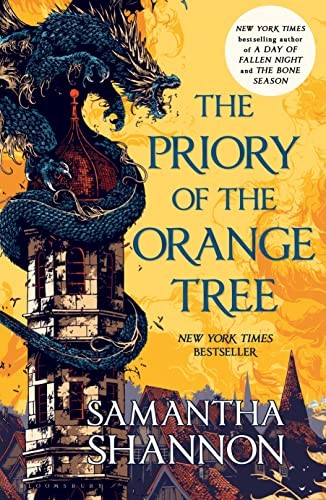
Talk to The Priory of the Orange Tree like its author wrote you back.
Get the ideas that fit your life — not generic summaries.
- Chat with the book
- Audiobook-style main ideas
- Adapts to your life and goals
- Helps you take action
The Priory of the Orange Tree, in detail
The Priory of the Orange Tree is an epic standalone fantasy novel set across multiple continents with distinct cultures, political systems, and relationships to dragons. The story follows four main characters: Ead, a secret member of the Priory of the Orange Tree (a sisterhood that guards a sleeping fire-breathing evil), who has been embedded in the court of a queen she must protect without revealing her order; Tané, a woman in the Eastern lands training to be a dragonrider for a culture that reveres water dragons entirely differently than the West fears fire ones; Loth, the queen's exiled friend; and Niclays, a disgraced scholar. As an ancient evil stirs, the novel gradually brings these threads toward convergence.
The most interesting thing the book does is position two entirely different religious and mythological systems as both partially right and partially distorted by centuries of institutional interest. The Western kingdoms worship a saint who supposedly defeated a great evil; the Eastern cultures venerate dragons rather than fearing them; the Priory holds a third, older account. Shannon is writing about how history gets rewritten to serve power, and about how much damage gets done in the name of a story that turns out to be incomplete.
Shannon's world-building is meticulous and her political structures are convincing. This is a 800-page book that earns its length — there is very little that could be cut without losing something. The queer romance at the center of the novel's most emotionally invested thread is handled with unusual care. Where the book sometimes struggles is pace: the first third is slow, and the convergence of the four POVs takes longer than some readers will want to wait.
The Priory of the Orange Tree is the kind of fantasy that readers who want a rich, fully imagined world with genuine stakes and a coherent political logic will find enormously satisfying. It asks something of the reader in terms of patience and investment. The reward is a fantasy novel that takes its world's history, religion, and gender politics seriously enough to build them into the resolution rather than treating them as backdrop.
The big ideas
- 1.
The competing mythologies — Western saint-worship, Eastern dragon reverence, the Priory's older knowledge — are the novel's central argument. History is told by those with the power to tell it.
- 2.
Shannon constructs two fully realized civilizations with different relationships to the same creatures (dragons) and the same threat. The contrast does real thematic work.
- 3.
Ead's position as a spy in a court she's genuinely attached to gives the novel its most sustained tension — the conflict between institutional loyalty and personal love.
