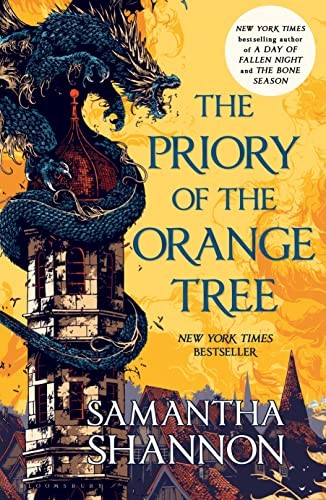
The Priory of the Orange Tree by Samantha Shannon is a 2019 fantasy book about religion and power, female agency, dragons and myth. The competing mythologies — Western saint-worship, Eastern dragon reverence, the Priory's older knowledge — are the novel's central argument. History is told by those with the power to tell it.
Summary
The Priory of the Orange Tree is an epic standalone fantasy novel set across multiple continents with distinct cultures, political systems, and relationships to dragons. The story follows four main characters: Ead, a secret member of the Priory of the Orange Tree (a sisterhood that guards a sleeping fire-breathing evil), who has been embedded in the court of a queen she must protect without revealing her order; Tané, a woman in the Eastern lands training to be a dragonrider for a culture that reveres water dragons entirely differently than the West fears fire ones; Loth, the queen's exiled friend; and Niclays, a disgraced scholar. As an ancient evil stirs, the novel gradually brings these threads toward convergence.
The most interesting thing the book does is position two entirely different religious and mythological systems as both partially right and partially distorted by centuries of institutional interest. The Western kingdoms worship a saint who supposedly defeated a great evil; the Eastern cultures venerate dragons rather than fearing them; the Priory holds a third, older account. Shannon is writing about how history gets rewritten to serve power, and about how much damage gets done in the name of a story that turns out to be incomplete.
Shannon's world-building is meticulous and her political structures are convincing. This is a 800-page book that earns its length — there is very little that could be cut without losing something. The queer romance at the center of the novel's most emotionally invested thread is handled with unusual care. Where the book sometimes struggles is pace: the first third is slow, and the convergence of the four POVs takes longer than some readers will want to wait.
The Priory of the Orange Tree is the kind of fantasy that readers who want a rich, fully imagined world with genuine stakes and a coherent political logic will find enormously satisfying. It asks something of the reader in terms of patience and investment. The reward is a fantasy novel that takes its world's history, religion, and gender politics seriously enough to build them into the resolution rather than treating them as backdrop.
Talk to The Priory of the Orange Tree like its author wrote you back.
Get the ideas that fit your life — not generic summaries.
- Chat with the book
- Audiobook-style main ideas
- Adapts to your life and goals
- Helps you take action
Key takeaways
- 1.
The competing mythologies — Western saint-worship, Eastern dragon reverence, the Priory's older knowledge — are the novel's central argument. History is told by those with the power to tell it.
- 2.
Shannon constructs two fully realized civilizations with different relationships to the same creatures (dragons) and the same threat. The contrast does real thematic work.
- 3.
Ead's position as a spy in a court she's genuinely attached to gives the novel its most sustained tension — the conflict between institutional loyalty and personal love.
- 4.
The queer romance is not incidental. Shannon is writing against the genre convention of heteronormative epic fantasy, and the relationship between Ead and Queen Sabran is the novel's emotional heart.
- 5.
The rewriting of founding myths as partial or deliberately distorted is the novel's political argument — one about how institutions maintain power through the stories they tell about their origins.
- 6.
Tané's thread is the most unfamiliar to Western fantasy readers, and the most interesting world-building in the book. Her culture's relationship with dragons reframes every scene about dragons in the Western storyline.
- 7.
At 800 pages, the novel is long by any standard. Shannon earns that length by making the convergence of the four storylines feel necessary rather than padded.
- 8.
The ending requires all four threads to have prepared the reader for a resolution that no single character could achieve. That structure is ambitious and largely successful.
Discussion questions
Use these on your own, with a book club, or as chat starters in Superbook. Book club version, ready to copy or print →
- 1.
The book presents two versions of history — the Western saint mythology and the Eastern dragon tradition — both of which turn out to be incomplete. What does the novel suggest about why institutions distort their own histories?
- 2.
Ead's secret endangers her and eventually forces a choice. How does the novel balance her loyalty to the Priory, her love for Sabran, and her own sense of what is true?
- 3.
Tané's culture treats dragons as sacred partners rather than existential threats. How does that cultural difference reframe the Western characters' understanding of the threat they're facing?
- 4.
The book is over 800 pages. Which of the four POVs did you find most essential, and is there any thread you think the novel could have shortened?
- 5.
Shannon positions queer identity — particularly Ead and Sabran's relationship — at the center of the novel's most important plot. Did that representation feel integrated into the story or like a deliberate statement alongside it?
- 6.
The villain's power depends on a mythological mistake that has been maintained for centuries. Does the novel's resolution feel satisfying given how long that mistake persisted?
- 7.
Compared to The Way Into Chaos (The Hundred Thousand Kingdoms), which also deals with religious history as political distortion, where does The Priory go further or less far?
- 8.
Niclays is an older male scholar whose story seems peripheral for much of the novel. How does his thread earn its place in the final convergence?
- 9.
The priory itself — a secret women's order maintaining a centuries-long vigil — is a fascinating institutional structure. What does Shannon seem to believe about the relationship between secrecy and institutional power?
- 10.
The four POV structure takes a while to pay off. At what point in your reading did you feel the structure was working, and at what point were you uncertain it would?
- 11.
Shannon deliberately inverted the standard epic fantasy template — the absent hero, the dragon as evil, the male-centered quest. Which of those inversions felt most effective, and which most self-conscious?
- 12.
The ending requires readers to have invested in all four storylines. Was your investment even across them, or were you reading some sections primarily to get back to others?
Themes
Frequently asked questions
-
Is The Priory of the Orange Tree a standalone novel?
Yes. It is a complete, self-contained story. A companion series (Roots of Chaos) is set in the same world, but The Priory stands entirely on its own.
-
Is The Priory of the Orange Tree hard to read?
It's long and the first third is slow as it establishes four separate storylines across multiple continents. The world-building is dense but not confusing. Most readers who push through the opening are well rewarded.
-
What makes The Priory of the Orange Tree notable in the fantasy genre?
It is a single-volume epic fantasy at a scale (850 pages, multiple continents, four POVs) usually reserved for multi-book series. It centers women and queer relationships throughout. And its treatment of competing religious mythologies as political distortion is unusually sophisticated.
-
Who shouldn't read The Priory of the Orange Tree?
Readers who want a fast, plot-driven book without investment in world-building, political history, or slow-burn romance. The first 200 pages are work. If that sounds exhausting rather than rewarding, this is not the right book for you.
-
Is there LGBTQ+ content in The Priory of the Orange Tree?
Yes — the central romance of the novel is between two women, and several other characters are queer. This is not incidental; it is central to the book's themes and story.