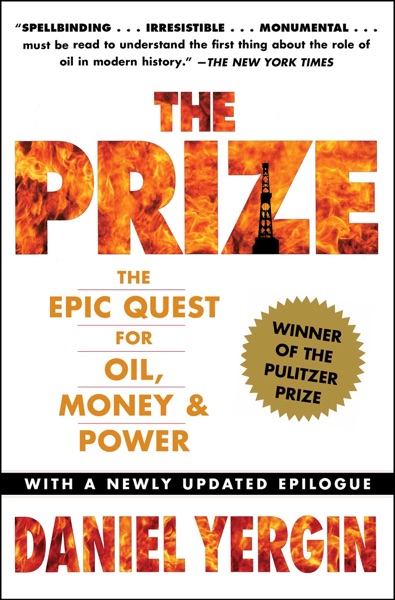
Talk to The Prize like its author wrote you back.
Get the ideas that fit your life — not generic summaries.
- Chat with the book
- Audiobook-style main ideas
- Adapts to your life and goals
- Helps you take action
The Prize, in detail
The Prize is Daniel Yergin's comprehensive history of the oil industry from its origins in Pennsylvania in 1859 through the Gulf War of 1990 and 1991. Yergin, an energy economist and historian, spent a decade researching the book and draws on archival material, company records, and interviews with industry figures across three continents. The result won the Pulitzer Prize for nonfiction in 1992 and remains the standard reference for anyone trying to understand how oil became the defining resource of the modern world.
The central argument is that oil is not just an economic commodity but a strategic one, and that its history is inseparable from the history of the twentieth century. Yergin traces the creation of Standard Oil and its breakup, the scramble for Baku and Persia before World War One, the role of oil logistics in both world wars, the founding of ARAMCO and the relationship between American oil companies and Saudi Arabia, the formation of OPEC, the 1973 embargo and its economic consequences, and the unraveling of the oil majors' control in the 1980s. Each chapter is a case study in how the economics of a single commodity interacts with politics, military strategy, and national interest.
What makes the book distinctive is its willingness to give equal weight to the business story and the geopolitical one. Readers interested in corporate history get detailed accounts of how Rockefeller built Standard Oil, how Royal Dutch Shell navigated two wars, and how the Texas independents dismantled the majors' price control in the 1980s. Readers interested in history get meticulous accounts of how oil supply shaped military planning in both world wars, what the Shah's relationship to American oil interests actually was, and why the 1973 embargo had the economic impact it did.
The Prize is long—nearly 800 pages—and it reads accordingly. Yergin's prose is clear and well-organized but rarely gripping; this is a work of historical scholarship written for a general audience rather than narrative nonfiction in the style of Erik Larson or Michael Lewis. For readers willing to invest the time, it's an unparalleled education in how the world's energy system was built, who controlled it, who fought over it, and how those fights shaped the map of the twentieth century.
The big ideas
- 1.
Oil is simultaneously an economic commodity and a strategic resource, and the tension between those two identities runs through every major conflict of the twentieth century.
- 2.
Standard Oil's dominance and breakup established the template for how governments think about industrial concentration in strategic sectors—a template still operating a century later.
- 3.
Britain and Germany's contrasting approaches to oil logistics before and during World War One were a significant factor in the war's outcome. Churchill's decision to convert the British Navy to oil made the stakes existential.
