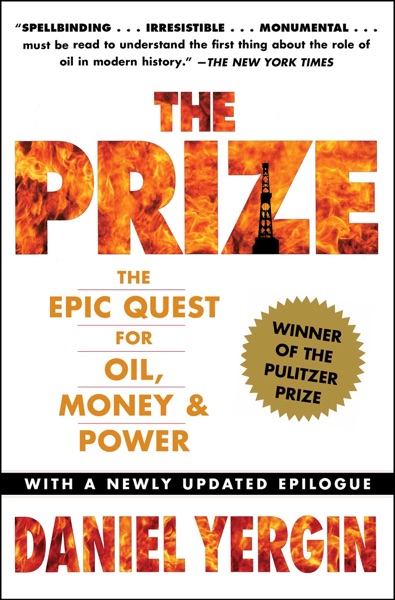
The Prize by Daniel Yergin is a 1991 history book about oil industry, geopolitics, energy. Oil is simultaneously an economic commodity and a strategic resource, and the tension between those two identities runs through every major conflict of the twentieth century.
Summary
The Prize is Daniel Yergin's comprehensive history of the oil industry from its origins in Pennsylvania in 1859 through the Gulf War of 1990 and 1991. Yergin, an energy economist and historian, spent a decade researching the book and draws on archival material, company records, and interviews with industry figures across three continents. The result won the Pulitzer Prize for nonfiction in 1992 and remains the standard reference for anyone trying to understand how oil became the defining resource of the modern world.
The central argument is that oil is not just an economic commodity but a strategic one, and that its history is inseparable from the history of the twentieth century. Yergin traces the creation of Standard Oil and its breakup, the scramble for Baku and Persia before World War One, the role of oil logistics in both world wars, the founding of ARAMCO and the relationship between American oil companies and Saudi Arabia, the formation of OPEC, the 1973 embargo and its economic consequences, and the unraveling of the oil majors' control in the 1980s. Each chapter is a case study in how the economics of a single commodity interacts with politics, military strategy, and national interest.
What makes the book distinctive is its willingness to give equal weight to the business story and the geopolitical one. Readers interested in corporate history get detailed accounts of how Rockefeller built Standard Oil, how Royal Dutch Shell navigated two wars, and how the Texas independents dismantled the majors' price control in the 1980s. Readers interested in history get meticulous accounts of how oil supply shaped military planning in both world wars, what the Shah's relationship to American oil interests actually was, and why the 1973 embargo had the economic impact it did.
The Prize is long—nearly 800 pages—and it reads accordingly. Yergin's prose is clear and well-organized but rarely gripping; this is a work of historical scholarship written for a general audience rather than narrative nonfiction in the style of Erik Larson or Michael Lewis. For readers willing to invest the time, it's an unparalleled education in how the world's energy system was built, who controlled it, who fought over it, and how those fights shaped the map of the twentieth century.
Talk to The Prize like its author wrote you back.
Get the ideas that fit your life — not generic summaries.
- Chat with the book
- Audiobook-style main ideas
- Adapts to your life and goals
- Helps you take action
Key takeaways
- 1.
Oil is simultaneously an economic commodity and a strategic resource, and the tension between those two identities runs through every major conflict of the twentieth century.
- 2.
Standard Oil's dominance and breakup established the template for how governments think about industrial concentration in strategic sectors—a template still operating a century later.
- 3.
Britain and Germany's contrasting approaches to oil logistics before and during World War One were a significant factor in the war's outcome. Churchill's decision to convert the British Navy to oil made the stakes existential.
- 4.
The US-Saudi oil relationship, formalized through ARAMCO in the 1940s, was the foundational arrangement of the postwar Middle East, with consequences that persist through the present.
- 5.
OPEC's 1973 embargo was not primarily an economic action. It was a deliberate exercise of political power by producer nations that had finally accumulated the leverage to act on grievances decades in the making.
- 6.
The 1973 price shock revealed how little modern economies had thought about energy security. The panic response—price controls, allocation queues, windfall taxes—mostly made things worse.
- 7.
The oil majors' decades-long control of global pricing collapsed in the 1980s under the combined pressure of conservation, new supply from Alaska and the North Sea, and OPEC's internal defection problem.
- 8.
The Gulf War of 1991 was, among other things, a demonstration that the US would use military force to protect the flow of oil from the Persian Gulf, establishing an expectation that persisted for decades.
Discussion questions
Use these on your own, with a book club, or as chat starters in Superbook. Book club version, ready to copy or print →
- 1.
Yergin argues that oil is fundamentally different from other commodities because of its strategic nature. Does that framing help explain current energy politics, or has something changed since 1991?
- 2.
The breakup of Standard Oil is often cited as a success of antitrust policy. Based on what you know from this book and elsewhere, is that the right lesson?
- 3.
Britain's decision to convert its navy to oil in 1912 was a gamble that paid off. How would you evaluate that kind of strategic bet in today's energy context?
- 4.
The US-Saudi relationship that Yergin traces was built on mutual interest, not mutual values. Is that a stable foundation for an alliance? What does the subsequent history tell you?
- 5.
OPEC's 1973 embargo was politically motivated but had economic effects that its organizers didn't fully anticipate. What does that tell you about the use of commodity supply as a geopolitical weapon?
- 6.
The US response to the 1973 oil shock—price controls, allocation rules—was widely criticized as counterproductive. Why do governments keep reaching for those tools despite the evidence?
- 7.
The book ends with the Gulf War. Looking at energy history since 1991, which of Yergin's themes from the book seem most prescient, and which seem most dated?
- 8.
Oil shaped the modern Middle East more than almost any other factor. What alternative histories were foreclosed by the discovery of oil in that region?
- 9.
Yergin is largely neutral about whether the oil industry has been good or bad for humanity. Where do you come down, and what evidence from the book informs your view?
- 10.
What parallels do you see between the history of oil and the emerging politics of critical minerals for batteries and renewable energy?
- 11.
The Prize was written before climate change became the dominant frame for thinking about energy. Does the book hold up, or does that omission fundamentally change what questions matter?
- 12.
What surprised you most about the history of oil as Yergin tells it?
Themes
Frequently asked questions
-
What is The Prize about?
The history of oil from its discovery in Pennsylvania in 1859 through the Gulf War in 1991, covering the rise and fall of Standard Oil, two world wars, the creation of OPEC, the 1973 oil shock, and the role of oil in shaping the modern world's politics and economy.
-
Is The Prize still relevant today?
Yes. The historical account is definitive and hasn't been superseded. Some of the analytical framework for thinking about current energy politics needs updating for the climate era, but the history itself is essential background for understanding how the current system got built.
-
How long does it take to read The Prize?
At average reading pace, roughly 20 hours for the nearly 800-page book. It's best read as a reference as much as a cover-to-cover narrative. The chapters stand reasonably well on their own if you're interested in specific periods.
-
Who should read The Prize?
Anyone interested in business history, geopolitics, energy policy, or the history of the twentieth century. It's required reading in many MBA and international relations programs and has remained in print for over 30 years.
-
What is the main lesson of The Prize?
That oil's importance is both economic and strategic, and that the two dimensions can't be separated. Decisions made for economic reasons have geopolitical consequences, and vice versa. The pattern has repeated across 130 years of oil history.
Similar books

Empire of Cotton: A Global History
Sven Beckert
The Shock Doctrine: The Rise of Disaster Capitalism
Naomi Klein
The Power Broker: Robert Moses and the Fall of New York
Robert A. Caro
Guns, Germs, and Steel
Jared Diamond
