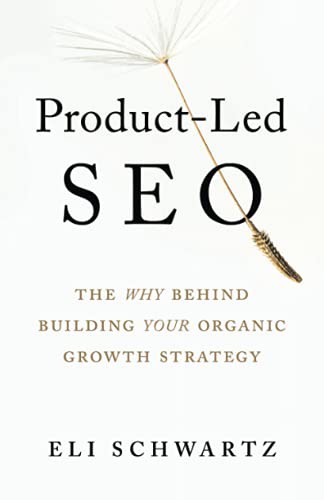
Product-Led SEO by Eli Schwartz is a 2021 business book about seo strategy, product-led growth, organic search. SEO strategy lives in product decisions, not content schedules. The companies with durable organic traffic built products that generate indexable value at scale.
Summary
Product-Led SEO is Eli Schwartz's argument that the most durable organic search strategies don't come from content teams churning out articles — they come from product decisions. Schwartz draws on his experience leading SEO at SurveyMonkey and consulting for major tech companies to make a case that the companies winning search are ones that build the web in ways Google cannot ignore: large-scale user-generated content, deeply structured data, tools that create indexable output, and pages that answer specific queries at scale.
The book distinguishes between "SEO tactics" and "SEO strategy." Tactics — optimizing title tags, building backlinks, updating meta descriptions — are maintenance. Strategy is deciding what kind of product generates organic traffic as a byproduct of being useful. Schwartz argues that the highest-leverage SEO work is done by product managers and engineers, not marketers, because it shapes what the site actually is at a structural level.
A large portion of the book focuses on user intent. Schwartz insists that before building any content or feature for SEO, teams need to understand precisely what users are trying to accomplish when they search. A keyword volume number tells you how often people search; understanding the intent behind that search tells you what they need. Building pages that answer intent correctly — not just pages that contain the right words — is what separates lasting rankings from short-lived ones.
The weaknesses are real. The book is more useful for people working on product-heavy, scalable SEO (marketplaces, SaaS tools, directories) than for individuals or small content businesses. Schwartz writes with authority but occasionally stays at the strategic altitude when practitioners would benefit from examples at the implementation level. For product managers and growth leads who haven't thought carefully about organic, it reads as a clear correction.
Talk to Product-Led SEO like its author wrote you back.
Get the ideas that fit your life — not generic summaries.
- Chat with the book
- Audiobook-style main ideas
- Adapts to your life and goals
- Helps you take action
Key takeaways
- 1.
SEO strategy lives in product decisions, not content schedules. The companies with durable organic traffic built products that generate indexable value at scale.
- 2.
Tactics and strategy are different things. Optimizing existing pages is maintenance; deciding what kinds of pages to build is strategy.
- 3.
User intent, not search volume, should drive what you build. A keyword's volume tells you how many people search; intent tells you what they need when they do.
- 4.
Programmatic SEO works when there is genuine underlying data or utility — not when it's thin pages assembled to game rankings.
- 5.
Engineers and product managers are often the most important SEO contributors because structural decisions compound over years.
- 6.
The best organic moats are products competitors can't easily copy: user-generated content, network effects, proprietary data sets.
- 7.
SEO attribution is hard and often misleading. Organic traffic credit gets stolen by paid and direct; the real test is what happens when you turn things off.
- 8.
Market research and keyword research are the same discipline approached from different angles. Both are about understanding what people want.
Discussion questions
Use these on your own, with a book club, or as chat starters in Superbook. Book club version, ready to copy or print →
- 1.
Schwartz argues SEO strategy is primarily a product decision. How does your organization currently divide responsibility for organic search, and where does that divide break down?
- 2.
What is one product feature at a company you admire that generates organic traffic as a side effect of being genuinely useful?
- 3.
Think of a keyword your product could rank for. What is the actual user intent behind it, and does your current page match that intent?
- 4.
Schwartz distinguishes between building SEO into the product and bolting it on afterward. Which description fits your current approach?
- 5.
How does your team currently measure the success of organic search efforts? What would a more honest measurement look like?
- 6.
What unique data or user-generated content does your product produce that competitors could not easily replicate?
- 7.
Where in your product does programmatic page generation make sense, and where would it produce low-quality pages that hurt more than help?
- 8.
Schwartz claims that long-tail intent is where product-led SEO often wins. What long-tail problems does your product solve that you haven't built pages around?
- 9.
How much of your SEO work is maintenance versus structural decisions? What would change if you shifted the ratio?
- 10.
Think of an SEO win your team had. Was it driven by a tactic or a product decision? How long did it hold?
- 11.
Schwartz says engineers often resist SEO requests because they see them as low-value shortcuts. How would you frame a product-led SEO project to a skeptical engineering team?
- 12.
What would your product look like if organic search growth were a primary design constraint from day one?
Themes
Frequently asked questions
-
What is Product-Led SEO about?
It argues that the most powerful SEO strategies are built into a product's structure rather than executed by a content team. Schwartz makes the case that the companies consistently winning organic traffic have built products — directories, tools, UGC platforms — that generate indexable, useful pages at scale.
-
Who should read Product-Led SEO?
Product managers, growth leads, and senior marketers at tech companies who have meaningful engineering resources. It is less useful for solo bloggers or small content businesses — Schwartz is writing primarily for teams that can actually change how their product generates pages.
-
Is Product-Led SEO still relevant after Google's algorithm updates?
More relevant, arguably. The book's core argument — that genuinely useful pages built around real user intent outperform thin content — is exactly what Google's helpful content and quality updates have been pushing the industry toward.
-
What is the most actionable idea in Product-Led SEO?
Start with user intent rather than keyword volume. Before building any content or feature for organic growth, Schwartz recommends understanding precisely what task a user is trying to complete when they search, then building something that fulfills that task rather than just containing the right words.
-
How long does it take to read Product-Led SEO?
Around three to four hours. It's a concise book at roughly 200 pages and reads quickly, though practitioners will likely slow down to take notes on the sections covering intent research and page-type strategy.
Similar books
Traction: How Any Startup Can Achieve Explosive Customer Growth
Gabriel Weinberg and Justin Mares

Hacking Growth
Sean Ellis and Morgan Brown
This Is Marketing: You Can't Be Seen Until You Learn to See
Seth Godin
Product-Led Growth
Wes Bush
