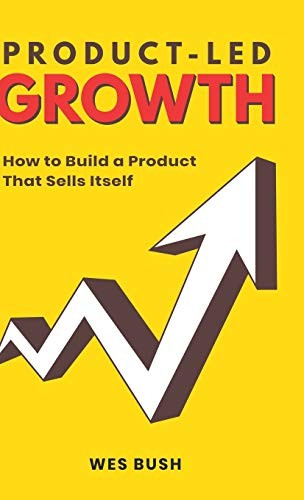
Product-Led Growth by Wes Bush is a 2019 business book about product strategy, growth, marketing. Product-led growth makes the product the primary driver of acquisition, conversion, and expansion, rather than relying on sales and marketing teams to generate and convert pipeline.
Summary
Product-Led Growth is Wes Bush's guide to a go-to-market strategy in which the product itself is the primary vehicle for customer acquisition, conversion, and expansion — rather than sales and marketing teams that generate leads and hand them to the product. Bush defines product-led growth as a business methodology where user acquisition, expansion, conversion, and retention are all driven primarily by the product. The classic examples are Slack, Dropbox, and Calendly: products that spread through usage, where the product becomes more valuable as more people use it, and where conversion to paid happens through the product's own value demonstration rather than through a sales conversation.
The book's main framework distinguishes between three go-to-market strategies: sales-led (a sales team owns the customer relationship and the product fulfills what sales promises), marketing-led (content and demand generation drive pipeline that sales converts), and product-led (the product creates its own pipeline by delivering enough value in a free tier that users and companies upgrade voluntarily). Bush argues that product-led growth is most powerful for software companies with horizontal products — tools that can be useful across many functions and company sizes — because the product can spread virally within organizations before any sales conversation happens.
The MOAT framework — Market Strategy, Ocean Conditions, Audience, and Time to Value — helps determine whether product-led growth is appropriate for a given product. Time to Value is particularly important: PLG works best when users can experience meaningful value quickly without requiring extensive onboarding, implementation, or sales education. Products with long time-to-value or complex implementation typically require a sales-assisted model even if they eventually convert to PLG at lower price points.
Bush also covers the specific mechanics of free trial and freemium design — choosing which features to include in the free tier, how to create conversion moments, and how to design the upgrade path. The book is direct and practical, though more focused on SaaS than other software models.
Talk to Product-Led Growth like its author wrote you back.
Get the ideas that fit your life — not generic summaries.
- Chat with the book
- Audiobook-style main ideas
- Adapts to your life and goals
- Helps you take action
Key takeaways
- 1.
Product-led growth makes the product the primary driver of acquisition, conversion, and expansion, rather than relying on sales and marketing teams to generate and convert pipeline.
- 2.
PLG works best for horizontal products — tools useful across many functions and company sizes — where viral spread within organizations can happen without a sales conversation.
- 3.
Time to Value is the most critical determinant of PLG viability. If users can't experience meaningful value quickly without assistance, the free tier creates frustration rather than conversion.
- 4.
The freemium decision requires choosing which features to put in the free tier: enough to create genuine value and viral spread, not so much that there is no incentive to upgrade.
- 5.
Conversion moments must be designed intentionally. Users upgrade when they hit a natural limit or discover a premium feature at the moment they need it, not because they received a sales email.
- 6.
Product Qualified Leads (PQLs) replace Marketing Qualified Leads: users who have experienced value in the product are better sales signals than users who downloaded a white paper.
- 7.
The bowling pin strategy for PLG: identify the job role or team that gets the most value from the product first, own them completely, then use those internal champions to expand to adjacent teams.
- 8.
PLG does not eliminate the need for sales — it changes when and how sales intervenes. Enterprise deals and complex implementations still require human relationships; PLG generates the inbound signal that triggers them.
Discussion questions
Use these on your own, with a book club, or as chat starters in Superbook. Book club version, ready to copy or print →
- 1.
What makes a product well-suited for product-led growth, and what makes it poorly suited? Use a specific product you know to work through the criteria.
- 2.
Bush argues that PLG reduces customer acquisition cost. Is that always true, or are there conditions where PLG actually increases CAC by requiring free infrastructure that supports non-paying users?
- 3.
What is the right balance between free and paid features in a freemium model? How do you avoid giving away so much that there's no reason to upgrade?
- 4.
Product Qualified Leads replace Marketing Qualified Leads in a PLG model. What does your product need to instrument and measure to generate reliable PQLs?
- 5.
PLG relies on viral spread within organizations. What network properties or collaboration features enable viral spread, and how do you design for them deliberately?
- 6.
How does sales fit into a product-led growth company? What do your salespeople do when the product generates its own pipeline?
- 7.
Slack, Dropbox, and Calendly are the canonical PLG examples. What makes them particularly well-suited to the model that other products lack?
- 8.
Time to Value is the most critical PLG variable. How do you measure TTV, and what investments — in onboarding, setup, templates — have the most impact on shortening it?
- 9.
How does a company transition from a sales-led model to a product-led model when it has an existing enterprise customer base and sales culture?
- 10.
Bush's framework focuses on SaaS. How does PLG apply to marketplace businesses, hardware companies, or B2B companies selling complex services?
- 11.
What are the organizational implications of PLG? Which teams own the free-to-paid conversion funnel, and how does that create conflict with or align with the product, marketing, and sales organizations?
Themes
Frequently asked questions
-
Is Product-Led Growth worth reading?
Yes, for anyone building or managing a SaaS product with a horizontal use case. It is concise and practical. If your product is highly vertical, requires complex implementation, or is sold entirely to the enterprise, the framework requires more significant adaptation.
-
What is the difference between freemium and free trial?
Freemium offers a permanently free tier with limited features; users upgrade when they need more. Free trial gives access to the full product for a limited period, after which users must pay or lose access. Both are PLG distribution models, and the choice depends on your product's Time to Value and the conversion moments that work best.
-
Does PLG require a self-serve checkout?
Not necessarily, but it works best with one. The PLG model is designed to reduce friction between product experience and payment. A self-serve checkout removes a step that sales-led models require, enabling conversion at the moment of maximum motivation.
-
How do you know if your product is ready for PLG?
The key questions: Can users experience meaningful value without a sales conversation or extensive onboarding? Is there a natural viral mechanism — collaboration features, external sharing, referral loops — that enables organic spread? Is there a clear upgrade path that users will discover through the product? If all three are yes, PLG is worth exploring.
-
What is a Product Qualified Lead?
A user who has taken specific actions in the product that signal they are ready for a sales conversation or likely to convert to paid. PQLs are defined by product engagement — activating key features, hitting usage limits, inviting teammates — rather than by content downloads or form fills.
Similar books
Inspired: How to Create Tech Products Customers Love
Marty Cagan
Traction: How Any Startup Can Achieve Explosive Customer Growth
Gabriel Weinberg and Justin Mares
Obviously Awesome
April Dunford

Hacking Growth
Sean Ellis and Morgan Brown
