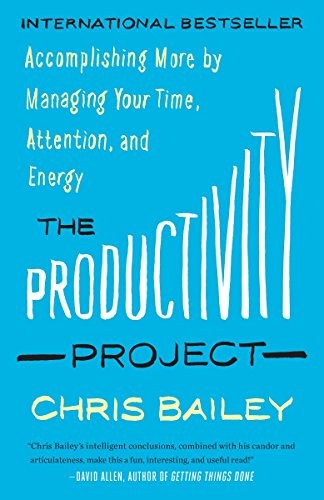
Talk to The Productivity Project like its author wrote you back.
Get the ideas that fit your life — not generic summaries.
- Chat with the book
- Audiobook-style main ideas
- Adapts to your life and goals
- Helps you take action
What it argues
The Productivity Project emerged from Chris Bailey's year-long self-experiment immediately after graduating from university. Instead of taking a job, he accepted two job offers and then deferred both to spend a year running productivity experiments on himself and writing about what he learned. He worked ninety-hour weeks and fifteen-hour weeks, meditated for thirty-five hours straight, and tried nearly every productivity technique he'd read about. The book is a synthesis of those experiments and the academic research that informed them.
Bailey's central reframe is that productivity is not about time management. Time is fixed and cannot be expanded. What you can expand are attention and energy — the two other resources that determine how much value you get from your hours. This triad is the book's backbone: time, attention, and energy. Most time management advice focuses almost exclusively on the first while neglecting the second and third.
What it gets right
- 1.
Productivity is the management of three resources — time, attention, and energy — not just time. Neglecting attention and energy is why most time management advice fails in practice.
- 2.
Work on your Most Important Tasks (MITs) during your peak biological hours, when attention and energy are highest. Save low-value maintenance work for troughs.
- 3.
The rule of three: at the start of each day, decide on three outcomes you want to accomplish. This creates a manageable focus without overwhelming with a long to-do list.
What it covers
Who wrote it
Chris Bailey is a Canadian productivity author and speaker who spent a year immediately after university running self-experiments on productivity instead of taking a conventional job. His writing on that year launched a website and consulting career. The Productivity Project was his first book, published in 2016, and he followed it with Hyperfocus in 2018. He speaks to organizations worldwide on the science of productivity and has been featured in the New York Times, Wall Street Journal, and Harvard Business Review.
