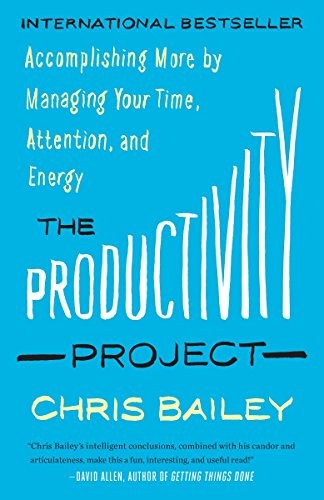
The Productivity Project by Chris Bailey is a 2016 self-help book about productivity, time management, attention. Productivity is the management of three resources — time, attention, and energy — not just time. Neglecting attention and energy is why most time management advice fails in practice.
Summary
The Productivity Project emerged from Chris Bailey's year-long self-experiment immediately after graduating from university. Instead of taking a job, he accepted two job offers and then deferred both to spend a year running productivity experiments on himself and writing about what he learned. He worked ninety-hour weeks and fifteen-hour weeks, meditated for thirty-five hours straight, and tried nearly every productivity technique he'd read about. The book is a synthesis of those experiments and the academic research that informed them.
Bailey's central reframe is that productivity is not about time management. Time is fixed and cannot be expanded. What you can expand are attention and energy — the two other resources that determine how much value you get from your hours. This triad is the book's backbone: time, attention, and energy. Most time management advice focuses almost exclusively on the first while neglecting the second and third.
The practical chapters are organized around this triad. On time: working on your most important tasks first (what he calls the rule of three and the MIT, or Most Important Tasks), scheduling maintenance work for your lowest-energy hours, and batching similar tasks to reduce switching costs. On attention: eliminating distractions, building a practice of single-tasking, and managing the internet as the primary attention thief. On energy: sleep, exercise, diet, alcohol, caffeine, and building daily and weekly rituals that sustain rather than drain capacity.
Bailey's self-experimental approach gives the book an honest, personal quality that distinguishes it from most productivity writing. He reports what didn't work as well as what did, and he acknowledges that different tactics work for different people. His recommendation throughout is to experiment on yourself rather than adopt someone else's complete system.
Talk to The Productivity Project like its author wrote you back.
Get the ideas that fit your life — not generic summaries.
- Chat with the book
- Audiobook-style main ideas
- Adapts to your life and goals
- Helps you take action
Key takeaways
- 1.
Productivity is the management of three resources — time, attention, and energy — not just time. Neglecting attention and energy is why most time management advice fails in practice.
- 2.
Work on your Most Important Tasks (MITs) during your peak biological hours, when attention and energy are highest. Save low-value maintenance work for troughs.
- 3.
The rule of three: at the start of each day, decide on three outcomes you want to accomplish. This creates a manageable focus without overwhelming with a long to-do list.
- 4.
Distraction from the internet is not a willpower problem — it is an environmental design problem. Making internet access harder during focused work is more effective than trying to resist.
- 5.
Single-tasking is more effective than multitasking for any cognitively demanding work. Each task switch costs time and attention, and the cost is larger than most people estimate.
- 6.
Maintenance tasks — email, scheduling, administrative work — expand to fill available time. Batching and time-limiting them prevents them from colonizing productive hours.
- 7.
Sleep and exercise have the largest return per hour of any energy-management investment. Both improve attention, mood, and cognitive performance more than any productivity app.
- 8.
Self-experimentation is the right approach to productivity: tactics that work for others may not work for you. Running controlled experiments on yourself builds a personalized system.
Discussion questions
Use these on your own, with a book club, or as chat starters in Superbook. Book club version, ready to copy or print →
- 1.
Bailey frames productivity around time, attention, and energy. Which of the three is your biggest constraint right now — the one that, if improved, would most change your output?
- 2.
When are your peak biological hours — the time of day when your attention and energy are highest? Is your current schedule actually protecting that time for your most important work?
- 3.
What are your three most important outcomes for this week? If you had to pick just three, what would they be?
- 4.
Bailey spent a week working ninety-hour weeks and another working twenty-hour weeks, producing roughly the same output. Does that match your experience? What would you find if you ran the same experiment?
- 5.
Which maintenance task most reliably expands to fill your productive time? Email, meetings, administrative work? What would batching it look like in your schedule?
- 6.
The book treats internet access as the primary attention thief in modern knowledge work. What is the specific access point — the app, the site, the notification — that most reliably derails your focus?
- 7.
Bailey describes his meditations and cold-shower experiments. What's the most uncomfortable productivity experiment you've ever run on yourself? What did you learn?
- 8.
He distinguishes between being busy and being productive. On a scale of one to ten, how would you rate your ratio of productive output to busy activity in a typical week?
- 9.
How much sleep do you actually get versus how much you think you need? What would a two-week experiment of eight hours per night show you?
- 10.
Bailey's approach is explicitly experimental rather than prescriptive. What is one productivity tactic you've read about but never actually tested? What would a two-week experiment with it look like?
- 11.
He talks about his period of working ninety hours a week and discovering diminishing returns past a certain point. At what point in your workday or workweek does your output quality noticeably drop?
- 12.
Which of the energy-management levers — sleep, exercise, diet, alcohol, caffeine — is most underused in your current routine? What's one small experiment you could run this week?
Themes
Frequently asked questions
-
Is The Productivity Project worth reading?
Yes, especially if you want a personal, experimental approach rather than a fixed system. Bailey's willingness to report what didn't work and his attention to energy and attention alongside time give it more depth than most productivity books.
-
How long does it take to read The Productivity Project?
About four to five hours at average pace. The chapters are organized around practical topics and can be read out of order if you have specific areas you want to address.
-
What is the main idea of The Productivity Project?
True productivity requires managing three resources — time, attention, and energy — not just time. Most time management advice fails because it ignores how depleted attention and energy undermine the best schedules.
-
How does The Productivity Project compare to Hyperfocus?
The Productivity Project is broader, covering all three resources. Hyperfocus focuses specifically on attention and how to direct it effectively. If you can only read one, The Productivity Project is the better starting point; Hyperfocus goes deeper on the attention piece.
-
Who should read The Productivity Project?
Knowledge workers who feel productive on paper but unsatisfied with their actual output. Also useful for people who suspect they're working too many hours for the results they're getting and want a research-backed framework for understanding why.