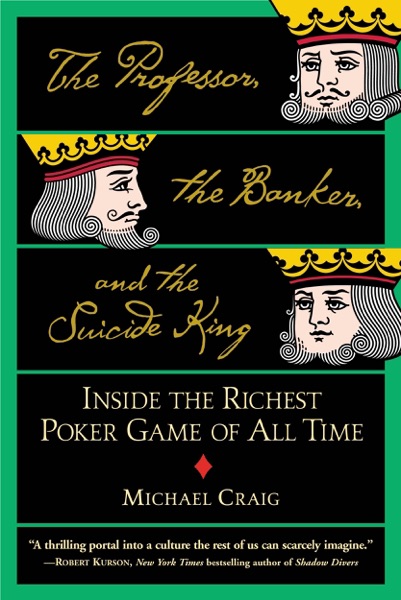
Talk to The Professor, the Banker, and the Suicide King like its author wrote you back.
Get the ideas that fit your life — not generic summaries.
- Chat with the book
- Audiobook-style main ideas
- Adapts to your life and goals
- Helps you take action
What it argues
The Professor, the Banker, and the Suicide King chronicles a series of high-stakes Texas Hold'em poker matches in 2001 between Andy Beal, a self-made Texas banker and real estate billionaire, and a rotating consortium of the world's best professional poker players, who called themselves the Corporation. The buy-ins reached into the millions. The story is remarkable both as poker narrative and as a study in the psychology of competition, ego, and money.
Beal's challenge was extraordinary by any measure. A non-professional who had taught himself the game through mathematical analysis and obsessive study, he arrived in Las Vegas and requested heads-up matches against the best players alive — Doyle Brunson, Chip Reese, Jennifer Harman, Howard Lederer, Ted Forrest, and others. Heads-up no-limit Hold'em at those stakes had never been played before. The Corporation formed partly because no individual player had the bankroll to absorb the variance a bankroll like Beal's could inflict.
What it gets right
- 1.
Heads-up no-limit poker at extreme stakes is as much a test of bankroll management and psychological endurance as it is of technical skill.
- 2.
The Corporation's structural advantage over Beal was risk pooling: they shared downside across multiple players while Beal absorbed all variance personally.
- 3.
Mathematical preparation can narrow the skill gap between an amateur and professionals, but it cannot eliminate the information edge that experienced players accumulate over years of reading opponents.
What it covers
Who wrote it
Michael Craig is an American journalist who has covered poker and gambling extensively for Card Player magazine and other publications. The Professor, the Banker, and the Suicide King, published in 2005, grew out of his reporting on the Andy Beal matches and remains his most widely read work. He has also written fiction and has contributed to several anthologies about cards and competition. His approach is that of a reporter rather than a participant — he interviewed the key players extensively rather than playing himself — which gives the book its relatively clear-eyed perspective on a world that frequently mythologizes its own participants.
