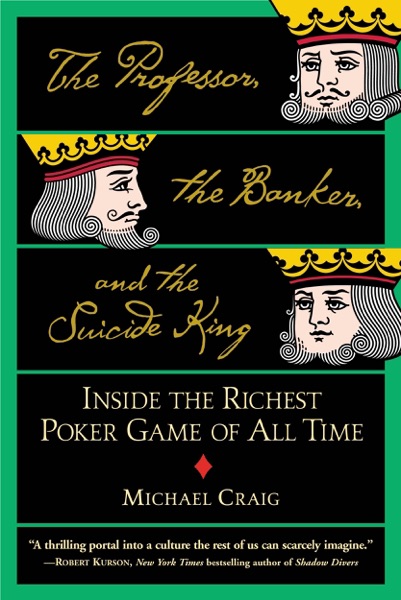
The Professor, the Banker, and the Suicide King by Michael Craig is a 2005 business book about poker, risk, gambling. Heads-up no-limit poker at extreme stakes is as much a test of bankroll management and psychological endurance as it is of technical skill.
Summary
The Professor, the Banker, and the Suicide King chronicles a series of high-stakes Texas Hold'em poker matches in 2001 between Andy Beal, a self-made Texas banker and real estate billionaire, and a rotating consortium of the world's best professional poker players, who called themselves the Corporation. The buy-ins reached into the millions. The story is remarkable both as poker narrative and as a study in the psychology of competition, ego, and money.
Beal's challenge was extraordinary by any measure. A non-professional who had taught himself the game through mathematical analysis and obsessive study, he arrived in Las Vegas and requested heads-up matches against the best players alive — Doyle Brunson, Chip Reese, Jennifer Harman, Howard Lederer, Ted Forrest, and others. Heads-up no-limit Hold'em at those stakes had never been played before. The Corporation formed partly because no individual player had the bankroll to absorb the variance a bankroll like Beal's could inflict.
Michael Craig reconstructs the matches from interviews with the participants, giving readers as close a view of elite poker thinking as exists outside the game itself. He traces how Beal prepared — the mathematical analysis, the pattern recognition, the deliberate attempts to negate poker's social dynamics by limiting information — and how the professionals adapted. The pros ultimately won more than they lost over the series, though Beal won several sessions and took several million dollars in the process. The structural advantage was always theirs: they were playing with house money in the sense that the Corporation pooled risk, while Beal was risking his own capital against players who were also his bankers.
Craig is a journalist and his prose serves the story rather than ornamenting it. The book does not romanticize gambling or pretend the stakes are anything other than money on a table. What it captures well is the psychology of extreme competition — the way two parties with incompatible views of their own skill can each be partially right, and the way ego and rational calculation are almost impossible to fully separate when the numbers get large enough.
Talk to The Professor, the Banker, and the Suicide King like its author wrote you back.
Get the ideas that fit your life — not generic summaries.
- Chat with the book
- Audiobook-style main ideas
- Adapts to your life and goals
- Helps you take action
Key takeaways
- 1.
Heads-up no-limit poker at extreme stakes is as much a test of bankroll management and psychological endurance as it is of technical skill.
- 2.
The Corporation's structural advantage over Beal was risk pooling: they shared downside across multiple players while Beal absorbed all variance personally.
- 3.
Mathematical preparation can narrow the skill gap between an amateur and professionals, but it cannot eliminate the information edge that experienced players accumulate over years of reading opponents.
- 4.
The professionals adapted their game specifically to counter Beal's analytical approach — strategy in competition is always a moving target.
- 5.
Ego and rational calculation are difficult to separate when the stakes are high enough that winning and losing become statements about who you are, not just how you played.
- 6.
Beal's approach — treating poker as a solvable mathematical problem — was partially successful and influenced how professionals thought about game theory in the years that followed.
- 7.
The variance in no-limit poker is large enough that even world-class players can lose significantly to a prepared amateur over any given series of sessions.
- 8.
Access to competition at the highest level often requires structural arrangements — in this case, a consortium — that would be impossible for individual actors to sustain.
Discussion questions
Use these on your own, with a book club, or as chat starters in Superbook. Book club version, ready to copy or print →
- 1.
Beal treated poker as a mathematical problem rather than a psychological one. How far did that approach take him, and where did it fall short?
- 2.
The Corporation pooled risk across players to counter Beal's bankroll. Is that a fundamentally different kind of competition, or just a rational response to asymmetric resources?
- 3.
The professionals adapted their strategy specifically to exploit Beal's analytical tendencies. In what situations in your own work have you seen someone's strength exploited as a weakness?
- 4.
Beal is a non-professional who studied obsessively to compete with the best. How much of his partial success do you attribute to skill, and how much to variance?
- 5.
The book is largely about money, but the players describe their motivation as competition rather than money at a certain level. Do you find that credible?
- 6.
Craig portrays the poker professionals with respect and complexity. Did that shift your assumptions about high-stakes gambling as a profession?
- 7.
The Corporation had to decide collectively how to respond to Beal — dividing sessions, sharing information, setting limits. What leadership and coordination problems did that create?
- 8.
Beal walked away a net loser overall but won enough sessions to sustain his belief in his approach. At what point does persistence in a losing strategy become irrational?
- 9.
The narrative frame is a journalist reconstructing events from interviews. What limitations does that create, and are there moments in the book where you felt it?
- 10.
The game is heads-up, which removes many of the multi-player dynamics poker is known for. How does the stakes change with one-on-one competition versus a full table?
- 11.
This all happened in 2001, before poker theory advanced significantly through solver software. How do you think the matches would differ today?
- 12.
The title names three archetypes — professor, banker, suicide king — without explaining them in the subtitle. What does each one represent to you after reading the book?
Themes
Frequently asked questions
-
Do I need to know poker to enjoy this book?
A basic understanding of Texas Hold'em helps, but Craig explains key concepts clearly enough that attentive readers without much poker background can follow the action. The psychological and competitive dynamics are accessible regardless of poker knowledge.
-
Is the book accurate? Did these matches really happen at these stakes?
Yes. The matches are well-documented, and several of the professionals involved have confirmed the account in interviews. The stakes described — sessions in the millions of dollars — were unprecedented at the time and have been verified by multiple participants.
-
Who won overall?
The Corporation won more than it lost over the full series. Beal won several individual sessions, including some very large ones, but the professionals had a structural edge through risk pooling and ultimately profited from the matchups in aggregate.
-
What's the most interesting strategic insight in the book?
The way the professionals adapted to Beal's mathematical approach is the most instructive part. Elite players are not just executing fixed strategies; they're modeling their opponent's model and adjusting. Beal's initial edge came from doing things the pros didn't expect; it eroded as they adjusted.
-
Is this a book about gambling or about competition?
Both, but the competitive psychology is the more durable subject. The specific context is high-stakes poker, but the dynamics — asymmetric resources, ego management, adapting to a specific opponent, risk pooling — appear in business, sports, and negotiation.
Similar books
Liar's Poker
Michael Lewis
Thinking in Bets: Making Smarter Decisions When You Don't Have All the Facts
Annie Duke
Moneyball: The Art of Winning an Unfair Game
Michael Lewis
A Man for All Markets
Edward O. Thorp
