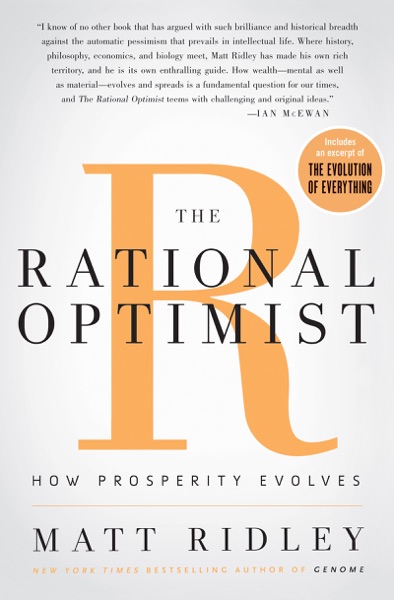
Talk to The Rational Optimist: How Prosperity Evolves like its author wrote you back.
Get the ideas that fit your life — not generic summaries.
- Chat with the book
- Audiobook-style main ideas
- Adapts to your life and goals
- Helps you take action
What it argues
Matt Ridley's argument in The Rational Optimist is evolutionary in the literal sense: he treats the expansion of human prosperity as the result of a Darwinian process operating at the cultural level, where ideas combine, compete, and recombine to produce innovations that raise living standards. The central mechanism is exchange. When two people trade, Ridley argues, they exchange not just goods but ideas embedded in those goods — making them both better off in material terms while also generating the possibility of new combinations. This is what he calls the collective brain: the distributed intelligence that emerges when humans specialize and exchange.
The first half of the book traces this story from hunter-gatherers through the Neolithic, the Bronze Age, classical antiquity, and into the industrial era, arguing that the moments when prosperity grew fastest were moments of intense exchange — the Mediterranean trading world of antiquity, the Islamic traders of the early medieval period, the North Sea economies of the later medieval period, the British industrial revolution. The moments of stagnation or reversal were moments of isolation, conquest, or political restriction of exchange.
What it gets right
- 1.
Trade is what makes humans uniquely prosperous: when people exchange goods and services, they exchange the ideas embedded in those products, creating a collective intelligence no individual possesses.
- 2.
Specialization and exchange allow individuals to consume things they could never produce themselves, raising living standards far above what self-sufficiency could achieve.
- 3.
Progress is not linear but punctuated: it accelerates when trade networks expand and reverses when they collapse. The Dark Ages were partly a story of trade network breakdown.
What it covers
Who wrote it
Matt Ridley is a British science writer, author, and hereditary peer in the House of Lords. He trained as a zoologist at Oxford and spent years as a science journalist before turning to popular non-fiction. His books include Genome, The Red Queen, Nature via Nurture, and The Evolution of Everything, all examining how evolutionary and market processes shape biological and cultural change. He served as chairman of Northern Rock, the British mortgage bank, during its 2007 failure and subsequent nationalization. He writes a regular column in The Times of London and is a vocal advocate for technological optimism and free markets.
