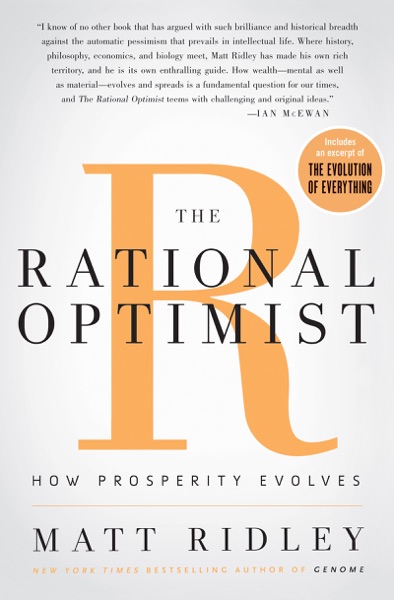
The Rational Optimist: How Prosperity Evolves by Matt Ridley is a 2010 economics book about human progress, trade and exchange, innovation. Trade is what makes humans uniquely prosperous: when people exchange goods and services, they exchange the ideas embedded in those products, creating a collective intelligence no individual possesses.
Summary
Matt Ridley's argument in The Rational Optimist is evolutionary in the literal sense: he treats the expansion of human prosperity as the result of a Darwinian process operating at the cultural level, where ideas combine, compete, and recombine to produce innovations that raise living standards. The central mechanism is exchange. When two people trade, Ridley argues, they exchange not just goods but ideas embedded in those goods — making them both better off in material terms while also generating the possibility of new combinations. This is what he calls the collective brain: the distributed intelligence that emerges when humans specialize and exchange.
The first half of the book traces this story from hunter-gatherers through the Neolithic, the Bronze Age, classical antiquity, and into the industrial era, arguing that the moments when prosperity grew fastest were moments of intense exchange — the Mediterranean trading world of antiquity, the Islamic traders of the early medieval period, the North Sea economies of the later medieval period, the British industrial revolution. The moments of stagnation or reversal were moments of isolation, conquest, or political restriction of exchange.
The second half turns more explicitly polemical. Ridley argues that contemporary pessimism about global warming, population growth, resource depletion, and technological risk is systematically miscalibrated — that the same pattern of innovation and adaptation that has solved previous resource and environmental challenges will continue to do so. Here the book generated its most substantive criticism. Ridley's tone becomes more confident than his evidence warrants, and his dismissal of climate risks in particular was criticized by scientists as going well beyond what the data supported.
The book is most useful for the first two-thirds, where the historical argument is rich and the empirical grounding is strong. The optimism about future technology solving current environmental challenges is less persuasive as argument than as temperamental stance, and should be held separately from the strength of the historical and economic case.
Talk to The Rational Optimist: How Prosperity Evolves like its author wrote you back.
Get the ideas that fit your life — not generic summaries.
- Chat with the book
- Audiobook-style main ideas
- Adapts to your life and goals
- Helps you take action
Key takeaways
- 1.
Trade is what makes humans uniquely prosperous: when people exchange goods and services, they exchange the ideas embedded in those products, creating a collective intelligence no individual possesses.
- 2.
Specialization and exchange allow individuals to consume things they could never produce themselves, raising living standards far above what self-sufficiency could achieve.
- 3.
Progress is not linear but punctuated: it accelerates when trade networks expand and reverses when they collapse. The Dark Ages were partly a story of trade network breakdown.
- 4.
Innovation is combinatorial: new ideas emerge from the meeting of old ones, which is why cities, trade routes, and open exchange generate more innovation than isolated communities.
- 5.
Resource scarcity has been a consistent prediction and a consistent failure: throughout history, human ingenuity has found substitutes for or more efficient uses of constrained resources.
- 6.
The Malthusian trap — population growth consuming all productivity gains — was broken by the industrial revolution, which generated growth faster than population could consume it.
- 7.
The expanding circle of exchange, from tribe to city to nation to global market, is the main story of economic history, and each expansion raised living standards.
- 8.
Contemporary pessimism about the future systematically underestimates the adaptive capacity of market economies and the human capacity for problem-solving under pressure.
Discussion questions
Use these on your own, with a book club, or as chat starters in Superbook. Book club version, ready to copy or print →
- 1.
Ridley's core mechanism is the exchange of ideas embedded in goods. Can you think of innovations in your own field that emerged from that kind of unexpected combination?
- 2.
He argues the historical record shows innovation solving resource constraints. Does climate change seem qualitatively different from previous resource challenges, or of the same type?
- 3.
The book is deliberately optimistic as a corrective to what Ridley sees as systematic media pessimism. Is that a legitimate intellectual stance, or does it introduce its own bias?
- 4.
Ridley draws a direct line from exchange to prosperity. Are there kinds of prosperity that do not depend on trade — communal, subsistence, or spiritual forms of flourishing?
- 5.
The collective brain idea implies that restricting exchange restricts innovation. Which restrictions on exchange — intellectual property, trade barriers, monopoly — seem most costly by this measure?
- 6.
Ridley is less interested in distribution than in aggregate growth. Who tends to be left out of his story of expanding prosperity?
- 7.
The book was published in 2010. Has the subsequent decade and a half vindicated or complicated its optimism about technology solving climate and resource problems?
- 8.
Ridley's second half is notably more polemical than his first. Why do you think he made that shift, and how does it affect the book's credibility?
- 9.
He argues that pessimists have been consistently wrong throughout history. Is being historically wrong a good reason to expect someone to be wrong about the future?
- 10.
The evolutionary framework treats cultural and economic change as Darwinian. What does that metaphor illuminate, and what might it obscure?
- 11.
Which historical period or civilization's experience did you find most illuminating in Ridley's account?
- 12.
Ridley is a hereditary peer who ran a bank that failed in 2007. Does that context affect how you read his arguments about markets and regulation?
Themes
Frequently asked questions
-
What is The Rational Optimist about?
It argues that human prosperity grows through exchange and specialization, that innovation emerges from the combination of ideas in open trading networks, and that pessimism about the future consistently underestimates human adaptive capacity. It traces this story from prehistoric trade through the industrial revolution to the present.
-
Is The Rational Optimist worth reading?
Yes, especially the historical sections on trade and prosperity. The second half, where Ridley becomes more polemical about climate and environmental risk, is weaker and should be read critically. The core economic argument is well-supported and genuinely illuminating.
-
How does The Rational Optimist compare to Factfulness?
Both make the empirical case that the world is improving and that we systematically underestimate progress. Factfulness focuses on misreading global development statistics; The Rational Optimist is more ambitious in building an economic theory of why prosperity grows. Ridley is also considerably more polemical about policy.
-
What are the main criticisms of The Rational Optimist?
That Ridley significantly understates the risks and mechanisms of climate change, that his optimism about future technological solutions is more assertion than argument, and that the distributional question — who benefits from growth — is largely absent from his account.
-
Who should read The Rational Optimist?
Readers interested in economic history and the deep roots of prosperity, people who want to understand the evolutionary case for trade and specialization, and anyone who finds unrelenting pessimism about the future emotionally or analytically unconvincing and wants evidence-based counterarguments.
Similar books
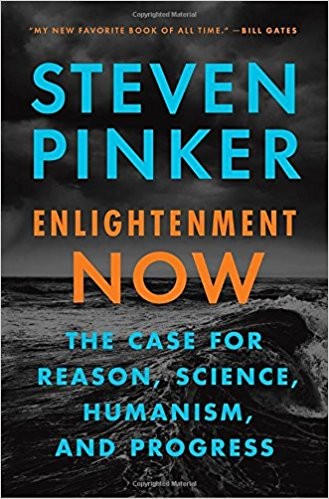
Enlightenment Now
Steven Pinker
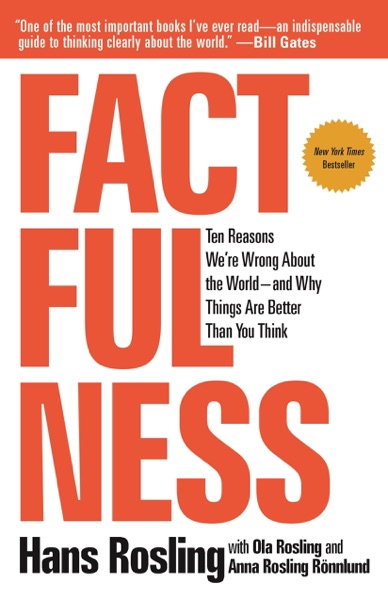
Factfulness: Ten Reasons We're Wrong About the World
Hans Rosling
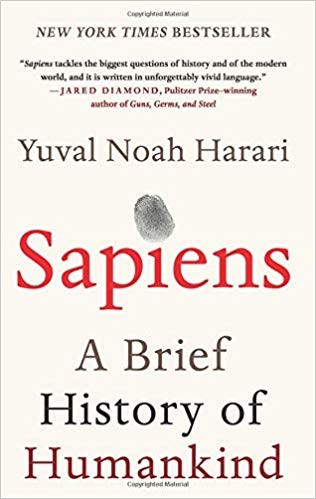
Sapiens: A Brief History of Humankind
Yuval Noah Harari
Guns, Germs, and Steel
Jared Diamond
