Economics · Book club
The Rise and Fall of American Growth book club questions
Here are 12 book club questions for The Rise and Fall of American Growth by Robert J. Gordon, ordered to open easily and end somewhere worth arguing about. Copy them, print them, or bring them up one at a time.
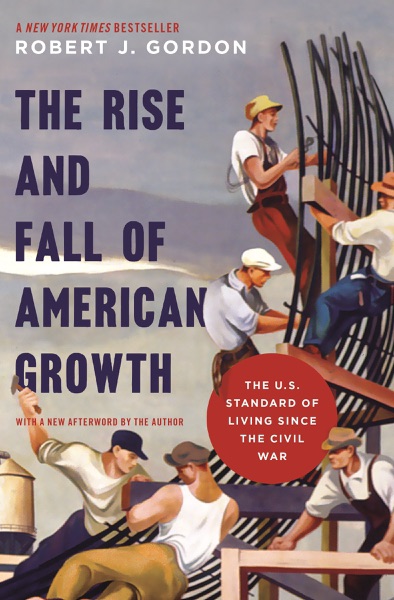
Robert Gordon's argument is one of the most carefully constructed and most contested in recent economics: that the period from 1870 to 1970 was a singular century of transformative invention, and that we have been living with the deceleration ever since.
Robert J. Gordon · 2016 · 15h 30m
Full summary and key takeaways →The 12 questions
- 1.
Gordon argues that electrification was more transformative than the internet. Do you find that persuasive? What would change about your life if you lost electricity versus lost internet access?
- 2.
His case depends on comparing the 1870–1970 period to everything before and after. Is there something circular about defining a baseline period as exceptional and then measuring everything else against it?
- 3.
Gordon identifies four headwinds to future growth. Which of the four do you think is the most binding constraint, and which do you think is most likely to be solved?
- 4.
The book argues that digital technology's productivity gains are real but narrow — they improved leisure and information without addressing the harder conditions of work and physical life. Where do you think that argument is strongest, and where does it break down?
- 5.
The social history chapters document what life was like without the conveniences we take for granted. What habit or technology in your own life, if removed, would most change your daily experience?
- 6.
Gordon is essentially a growth pessimist about the future. What evidence would change your mind about his forecast — either in the direction of greater or lesser pessimism?
- 7.
The book argues that inequality doesn't just matter morally but economically — it suppresses productivity gains in the aggregate by concentrating them at the top. Do you find the economic argument for reducing inequality more or less compelling than the moral one?
- 8.
Gordon's critics argue he underestimates AI and biomedical innovation. How do you weigh the argument that transformative change is still ahead against the historical record of previous waves of technology not meeting the standard he sets?
- 9.
The book is seven hundred pages of dense economic history. What is lost by reading a summary rather than the full argument? Is there an argument that length is a form of evidence?
- 10.
Gordon separates the great century of invention from the previous and subsequent periods. Does that framing capture something real, or does it create an artificial discontinuity?
- 11.
The book treats American growth as the central subject. How much of its argument applies to developing economies, where the 1870–1970 transformations have yet to fully arrive?
- 12.
If Gordon's pessimism about growth is even partially correct, what are the political implications? What policies would make sense in a world of structurally constrained growth?
How to run the discussion
- Pick six to eight, not all of them. An hour of real discussion covers fewer questions than anyone expects, and racing the list is what makes a book club feel like homework.
- Open with what people noticed, not what they concluded. Asking for a verdict first hardens opinions before anyone has heard each other.
- Let the disagreement run. The questions below that split a room are the ones worth the time; the ones everyone answers the same way can be skipped.
- Ask the quiet person a specific question. A direct, narrow question is far easier to answer than an open invitation to contribute.
Themes worth steering toward
If the conversation stalls, these are the threads that usually restart it.
Common questions
What are good book club questions for The Rise and Fall of American Growth?
Here are 12 book club questions for The Rise and Fall of American Growth by Robert J. Gordon, ordered to open easily and end somewhere worth arguing about. The strongest openers ask what each reader noticed rather than what they concluded, and the discussion usually turns on economic growth, technological progress, inequality.
How long should a book club discussion of The Rise and Fall of American Growth last?
Most groups run 60 to 90 minutes of actual discussion. That is roughly six to eight questions, not all of them, so pick the ones that suit your group rather than working down the list in order.
What are the main themes in The Rise and Fall of American Growth?
Economic growth, Technological progress, Inequality, American history, Innovation and productivity. Those are the threads most likely to divide a room, which makes them the useful places to steer a discussion that has gone quiet.
Picking the next one? See books like The Rise and Fall of American Growth or questions for other book club picks.
