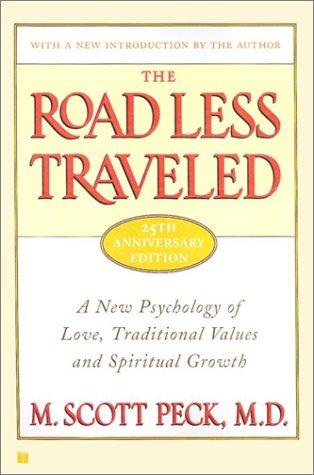
Talk to The Road Less Traveled like its author wrote you back.
Get the ideas that fit your life — not generic summaries.
- Chat with the book
- Audiobook-style main ideas
- Adapts to your life and goals
- Helps you take action
What it argues
The Road Less Traveled opens with one of the most direct sentences in self-help literature: "Life is difficult." Peck's argument is that this is not a complaint but a liberation — once you genuinely accept that suffering is intrinsic to life rather than a problem to be solved, you stop wasting energy resisting it and can begin the actual work of growth. The book divides into four sections: discipline, love, growth and religion, and grace. Each builds on the last.
Peck defines discipline as the set of tools required to solve life's problems. He identifies four: delaying gratification (doing the hard thing first), accepting responsibility (refusing to blame others for your situation), dedication to truth (seeing reality as it actually is, not as you wish it were), and balancing (the willingness to give up one value for a higher one). Without these tools, no growth is possible. The failure of discipline, in Peck's clinical view, is the root of most psychological suffering.
What it gets right
- 1.
Life is difficult. Accepting this fact rather than fighting it is the first move toward genuine psychological health.
- 2.
Discipline consists of four practices: delaying gratification, accepting responsibility, dedication to truth, and balancing. Without them, no real problem-solving is possible.
- 3.
Falling in love is not love. It is a temporary dissolution of ego boundaries — intense but transient. Real love is an act of will, not a feeling.
What it covers
Who wrote it
M. Scott Peck (1936–2005) was an American psychiatrist and author whose clinical practice spanned more than three decades. He trained at Harvard and Case Western Reserve University and served as a psychiatrist in the US Army before entering private practice. The Road Less Traveled, published in 1978, spent more than a decade on the New York Times bestseller list — an unusual record for a book of serious psychological and philosophical argument. His later books include People of the Lie, The Different Drum, and A World Waiting to Be Born. Peck converted to Christianity in 1980, and religious themes became increasingly central to his subsequent work.
