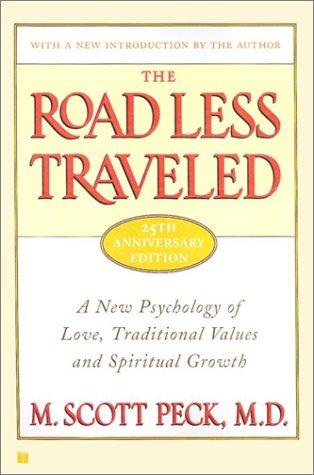
Talk to The Road Less Traveled like its author wrote you back.
Get the ideas that fit your life — not generic summaries.
- Chat with the book
- Audiobook-style main ideas
- Adapts to your life and goals
- Helps you take action
The Road Less Traveled, in detail
The Road Less Traveled opens with one of the most direct sentences in self-help literature: "Life is difficult." Peck's argument is that this is not a complaint but a liberation — once you genuinely accept that suffering is intrinsic to life rather than a problem to be solved, you stop wasting energy resisting it and can begin the actual work of growth. The book divides into four sections: discipline, love, growth and religion, and grace. Each builds on the last.
Peck defines discipline as the set of tools required to solve life's problems. He identifies four: delaying gratification (doing the hard thing first), accepting responsibility (refusing to blame others for your situation), dedication to truth (seeing reality as it actually is, not as you wish it were), and balancing (the willingness to give up one value for a higher one). Without these tools, no growth is possible. The failure of discipline, in Peck's clinical view, is the root of most psychological suffering.
The section on love is the most philosophically careful. Peck argues that falling in love is not love at all but a temporary collapse of ego boundaries — an illusion of union that is chemically normal and emotionally intense but not sustainable. Real love, he argues, is an act of will: the extension of the self for the purpose of nurturing another's spiritual growth. This definition includes but is not limited to romantic love. It also applies to how a therapist relates to a patient, a parent to a child, or a person to themselves.
The final sections move explicitly into religious territory. Peck argues that the unconscious is itself a form of grace — that human beings are pulled toward growth and consciousness by a force larger than their conscious will. Whether readers accept the theological framing or not, Peck's clinical observation holds: most people are more capable of growth than they believe, and the barriers are largely self-constructed. The book has its weaknesses — some sections date badly, and the therapeutic case studies reflect assumptions that would not survive modern scrutiny. But its central argument about discipline and the will to love remains quietly demanding.
The big ideas
- 1.
Life is difficult. Accepting this fact rather than fighting it is the first move toward genuine psychological health.
- 2.
Discipline consists of four practices: delaying gratification, accepting responsibility, dedication to truth, and balancing. Without them, no real problem-solving is possible.
- 3.
Falling in love is not love. It is a temporary dissolution of ego boundaries — intense but transient. Real love is an act of will, not a feeling.
