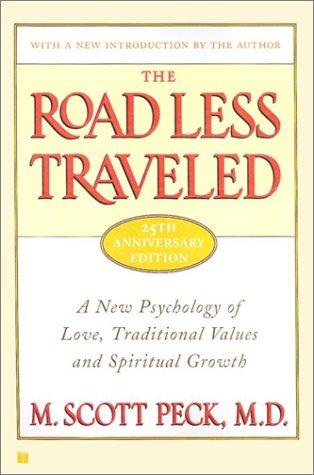
The Road Less Traveled by M. Scott Peck is a 1978 philosophy book about discipline, love, spiritual growth. Life is difficult. Accepting this fact rather than fighting it is the first move toward genuine psychological health.
Summary
The Road Less Traveled opens with one of the most direct sentences in self-help literature: "Life is difficult." Peck's argument is that this is not a complaint but a liberation — once you genuinely accept that suffering is intrinsic to life rather than a problem to be solved, you stop wasting energy resisting it and can begin the actual work of growth. The book divides into four sections: discipline, love, growth and religion, and grace. Each builds on the last.
Peck defines discipline as the set of tools required to solve life's problems. He identifies four: delaying gratification (doing the hard thing first), accepting responsibility (refusing to blame others for your situation), dedication to truth (seeing reality as it actually is, not as you wish it were), and balancing (the willingness to give up one value for a higher one). Without these tools, no growth is possible. The failure of discipline, in Peck's clinical view, is the root of most psychological suffering.
The section on love is the most philosophically careful. Peck argues that falling in love is not love at all but a temporary collapse of ego boundaries — an illusion of union that is chemically normal and emotionally intense but not sustainable. Real love, he argues, is an act of will: the extension of the self for the purpose of nurturing another's spiritual growth. This definition includes but is not limited to romantic love. It also applies to how a therapist relates to a patient, a parent to a child, or a person to themselves.
The final sections move explicitly into religious territory. Peck argues that the unconscious is itself a form of grace — that human beings are pulled toward growth and consciousness by a force larger than their conscious will. Whether readers accept the theological framing or not, Peck's clinical observation holds: most people are more capable of growth than they believe, and the barriers are largely self-constructed. The book has its weaknesses — some sections date badly, and the therapeutic case studies reflect assumptions that would not survive modern scrutiny. But its central argument about discipline and the will to love remains quietly demanding.
Talk to The Road Less Traveled like its author wrote you back.
Get the ideas that fit your life — not generic summaries.
- Chat with the book
- Audiobook-style main ideas
- Adapts to your life and goals
- Helps you take action
Key takeaways
- 1.
Life is difficult. Accepting this fact rather than fighting it is the first move toward genuine psychological health.
- 2.
Discipline consists of four practices: delaying gratification, accepting responsibility, dedication to truth, and balancing. Without them, no real problem-solving is possible.
- 3.
Falling in love is not love. It is a temporary dissolution of ego boundaries — intense but transient. Real love is an act of will, not a feeling.
- 4.
Love is the willingness to extend the self for the purpose of nurturing another's spiritual growth. This is a definition that demands effort, not just emotion.
- 5.
Most people avoid responsibility by blaming circumstances or others. Accepting that your life is your own to shape is uncomfortable and necessary.
- 6.
Dedication to truth means being willing to revise your map of reality when the territory doesn't match. Clinging to outdated beliefs is a form of laziness.
- 7.
Neurosis is the avoidance of legitimate suffering. Character disorder is the avoidance of responsibility. Peck sees both as failures to engage with the difficulty of life.
- 8.
Grace — the force that seems to move people toward growth even without their conscious effort — is real in Peck's clinical observation, whatever one makes of its theological interpretation.
Discussion questions
Use these on your own, with a book club, or as chat starters in Superbook. Book club version, ready to copy or print →
- 1.
Peck opens with 'Life is difficult.' Has accepting this statement — rather than fighting it — changed anything in your own life?
- 2.
Which of Peck's four tools of discipline do you find hardest to practice consistently: delaying gratification, accepting responsibility, dedication to truth, or balancing?
- 3.
Peck argues that falling in love is not love. How does his definition of love as an act of will sit with your own experience of close relationships?
- 4.
Think of a relationship where you extended yourself for someone else's growth at real cost to yourself. What made you willing to do that?
- 5.
Peck distinguishes neurosis (avoiding legitimate suffering) from character disorder (avoiding responsibility). Which tendency do you recognize more in yourself?
- 6.
What is a belief about reality you currently hold that you suspect might need revising? What would it take to actually revise it?
- 7.
Peck argues that responsibility is the foundation of psychological health. Where in your life are you still waiting for circumstances or other people to change?
- 8.
The section on grace suggests that people are pulled toward growth by forces beyond their conscious will. Does that match your experience? What examples do you have?
- 9.
Peck's clinical case studies reflect 1970s therapeutic assumptions. Which parts of the book feel dated, and which parts still land?
- 10.
Balancing means giving up one value for a higher one. What have you genuinely given up in the name of growth, and was the tradeoff worth it?
- 11.
Peck says the goal of spiritual growth is to merge one's self with a larger intelligence. How do you relate to that claim, regardless of your religious or philosophical commitments?
- 12.
If you read this book earlier in your life, what did you take from it then? Reading it now (or for the first time), what do you take from it?
Themes
Frequently asked questions
-
What is The Road Less Traveled about?
It is a psychiatrist's account of what genuine psychological and spiritual growth requires. Peck argues that growth demands discipline, authentic love, and the willingness to accept responsibility for one's life — and that most human suffering comes from avoiding these demands.
-
Is The Road Less Traveled worth reading?
Yes, with caveats. The first two sections on discipline and love contain insights that hold up well. The later sections become more explicitly religious and reflect therapeutic assumptions from the 1970s that are now contested. Read for the core argument rather than the case studies.
-
How long does it take to read The Road Less Traveled?
Roughly five to six hours at average reading pace. The book is 316 pages in most editions and written in plain, accessible prose. It reads faster than its philosophical depth might suggest.
-
What is the most challenging idea in The Road Less Traveled?
Peck's argument that most human suffering is self-inflicted — the result of avoiding responsibility, evading truth, or refusing to delay gratification. It is not a comforting book. It asks readers to be honest about their own role in creating the problems they face.
-
Who should read The Road Less Traveled?
Anyone interested in the intersection of psychology and philosophy, or anyone who feels stuck and suspects the obstacle is internal rather than external. It is most useful for readers willing to engage with its religious framework, or at least bracket it.
-
How does The Road Less Traveled differ from modern self-help?
It is more demanding and less optimistic. Peck does not promise quick results or offer techniques for feeling better. He argues that growth is hard, takes years, and requires genuine honesty about one's failures. Most modern self-help avoids that level of directness.