Talk to The Road to Serfdom like its author wrote you back.
Get the ideas that fit your life — not generic summaries.
- Chat with the book
- Audiobook-style main ideas
- Adapts to your life and goals
- Helps you take action
What it argues
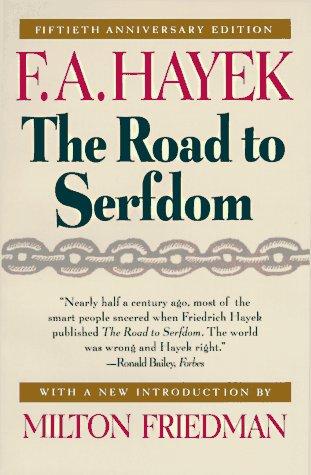
The Road to Serfdom, published in 1944, is Friedrich Hayek's argument that central economic planning is incompatible with political freedom and will, regardless of intent, produce a form of totalitarianism. Writing during the Second World War, Hayek was primarily addressing the British and American left, which had absorbed socialist ideas about state direction of the economy as a progressive alternative to both fascism and unregulated capitalism. His central contention was that these critics misunderstood the relationship between fascism and socialism: both required the same concentration of economic power, and the power concentrated for good ends would inevitably be turned to oppressive ones.
Hayek's argument proceeds from his analysis of dispersed knowledge. No central authority can possess the information necessary to coordinate a complex economy because the relevant knowledge is distributed across millions of individual decisions, preferences, and local circumstances. Prices in a market system aggregate and transmit this information in ways no planner can replicate. Central planning therefore requires both the substitution of one authority's values for the diverse values of individuals and the suppression of the spontaneous order that actually makes economic coordination possible.
What it gets right
- 1.
Central economic planning requires concentrating authority in ways that are structurally incompatible with individual freedom and the rule of law.
- 2.
No planning authority can possess the dispersed local knowledge that price systems aggregate and transmit; central plans substitute one authority's values and information for the diversity of millions.
- 3.
Fascism and socialism, despite their apparent opposition, share a structural similarity: both require comprehensive state control of economic life.
What it covers
Who wrote it
Friedrich August Hayek (1899–1992) was an Austrian-British economist and political philosopher. He shared the Nobel Memorial Prize in Economic Sciences in 1974 with Gunnar Myrdal. His academic work spans business cycle theory, epistemology, and political philosophy, with major works including The Pure Theory of Capital, The Constitution of Liberty, and the three-volume Law, Legislation and Liberty. He taught at the London School of Economics, the University of Chicago, and the University of Freiburg. Hayek's influence on Anglo-American economic policy in the 1970s and 1980s was substantial and remains contested.
