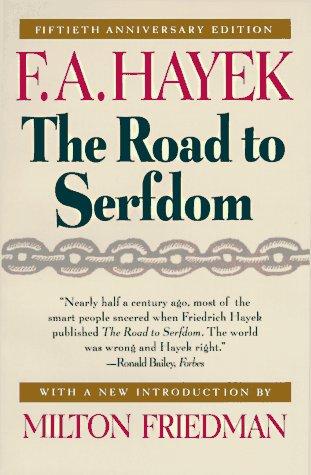
Talk to The Road to Serfdom like its author wrote you back.
Get the ideas that fit your life — not generic summaries.
- Chat with the book
- Audiobook-style main ideas
- Adapts to your life and goals
- Helps you take action
The Road to Serfdom, in detail
The Road to Serfdom, published in 1944, is Friedrich Hayek's argument that central economic planning is incompatible with political freedom and will, regardless of intent, produce a form of totalitarianism. Writing during the Second World War, Hayek was primarily addressing the British and American left, which had absorbed socialist ideas about state direction of the economy as a progressive alternative to both fascism and unregulated capitalism. His central contention was that these critics misunderstood the relationship between fascism and socialism: both required the same concentration of economic power, and the power concentrated for good ends would inevitably be turned to oppressive ones.
Hayek's argument proceeds from his analysis of dispersed knowledge. No central authority can possess the information necessary to coordinate a complex economy because the relevant knowledge is distributed across millions of individual decisions, preferences, and local circumstances. Prices in a market system aggregate and transmit this information in ways no planner can replicate. Central planning therefore requires both the substitution of one authority's values for the diverse values of individuals and the suppression of the spontaneous order that actually makes economic coordination possible.
The political logic follows: planning requires authority, authority requires coercion, and coercion applied systematically to economic life cannot be limited to economic life. The characteristics Hayek identifies in Nazi Germany — the displacement of the rule of law by administrative discretion, the subordination of minority interests to collective goals, the rise of the "worst" to positions of power because they are least constrained by moral scruple — follow, he argues, from the structure of central planning itself, not from the particular ideology of the planners.
Hayek is careful to distinguish his argument from opposition to all state action. He supports a robust social safety net, competition law, and public goods provision. His target is comprehensive economic direction, not the welfare state. This nuance has often been lost in both the enthusiastic embrace of the book by market fundamentalists and in critiques that reduce it to a crude defense of laissez-faire. The book remains contested and influential: it helped shape postwar economic liberalism, was cited by Thatcher and Reagan, and continues to frame debates about the state's role in economic life.
The big ideas
- 1.
Central economic planning requires concentrating authority in ways that are structurally incompatible with individual freedom and the rule of law.
- 2.
No planning authority can possess the dispersed local knowledge that price systems aggregate and transmit; central plans substitute one authority's values and information for the diversity of millions.
- 3.
Fascism and socialism, despite their apparent opposition, share a structural similarity: both require comprehensive state control of economic life.
