Talk to The Road like its author wrote you back.
Get the ideas that fit your life — not generic summaries.
- Chat with the book
- Audiobook-style main ideas
- Adapts to your life and goals
- Helps you take action
The Road, in detail
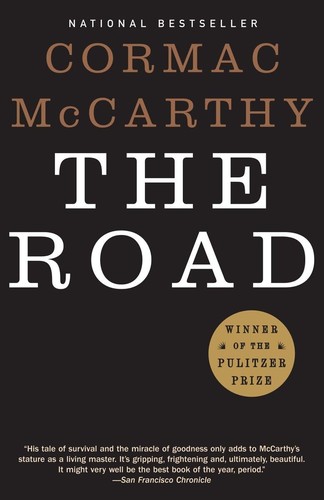
The Road follows a man and his young son crossing a post-apocalyptic America — grey ash, dead forests, roads clogged with the rusted shells of cars, occasional gangs of survivors who have become predatory. There is no named cause for the catastrophe. There are no dates. The characters have no names: they are only "the man" and "the boy." They are heading south toward the coast, though neither knows what they'll find there. They are "carrying the fire" — a phrase that becomes the novel's moral and emotional axis.
McCarthy's subject is what love demands of a person in conditions that strip everything else away. The man has made a single decision: he will keep the boy alive, and he will keep the boy good, even though the boy's goodness is a constant source of anguish because the world they're moving through punishes it. The tension between survival at any cost and maintaining moral identity runs through every encounter, every decision about food, shelter, and what to do when they meet other people. The boy consistently asks for more mercy than his father can give.
The prose is stripped of punctuation — no apostrophes, no quotation marks, dialogue untagged — in a way that initially seems affectation but proves structural. The flatness of the prose matches the landscape; the absence of conventional grammar mirrors a world where the rules of civilization have fallen away. McCarthy writes physical desolation with extraordinary precision, and the boy's voice — earnest, questioning, morally insistent — contrasts with the landscape in a way that produces genuine emotional pressure.
Published in 2006 and a Pulitzer Prize winner, The Road is the most accessible of McCarthy's major novels. It's far shorter and more conventionally plotted than Blood Meridian or Suttree, and its emotional core — a father's love for a child — is immediately legible. Some readers find the unrelenting grimness too much; others find that McCarthy earns his darkness by making the love between the man and boy feel real. It is emphatically not a hopeful book, but it ends on something the novel seems to argue is harder than hope: evidence.
The big ideas
- 1.
The novel treats love as its own kind of survival problem — the man's love for the boy is both the reason to keep going and the source of his most unbearable fear.
- 2.
'Carrying the fire' is never defined precisely, which is the point. The phrase stands for moral integrity, human decency, the refusal to become what the worst survivors have become.
- 3.
The boy is morally cleaner than the man throughout, and the man knows it. The son is in some sense the father's conscience as much as the reverse.
