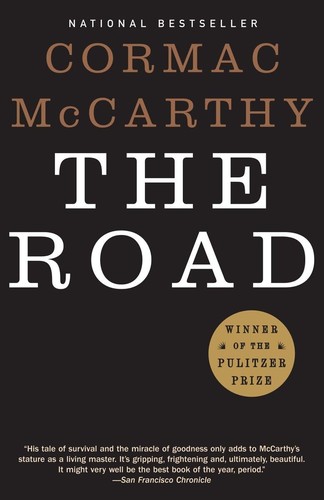
The Road by Cormac McCarthy is a 2006 literary fiction book about survival, fatherhood, hope and despair. The novel treats love as its own kind of survival problem — the man's love for the boy is both the reason to keep going and the source of his most unbearable fear.
Summary
The Road follows a man and his young son crossing a post-apocalyptic America — grey ash, dead forests, roads clogged with the rusted shells of cars, occasional gangs of survivors who have become predatory. There is no named cause for the catastrophe. There are no dates. The characters have no names: they are only "the man" and "the boy." They are heading south toward the coast, though neither knows what they'll find there. They are "carrying the fire" — a phrase that becomes the novel's moral and emotional axis.
McCarthy's subject is what love demands of a person in conditions that strip everything else away. The man has made a single decision: he will keep the boy alive, and he will keep the boy good, even though the boy's goodness is a constant source of anguish because the world they're moving through punishes it. The tension between survival at any cost and maintaining moral identity runs through every encounter, every decision about food, shelter, and what to do when they meet other people. The boy consistently asks for more mercy than his father can give.
The prose is stripped of punctuation — no apostrophes, no quotation marks, dialogue untagged — in a way that initially seems affectation but proves structural. The flatness of the prose matches the landscape; the absence of conventional grammar mirrors a world where the rules of civilization have fallen away. McCarthy writes physical desolation with extraordinary precision, and the boy's voice — earnest, questioning, morally insistent — contrasts with the landscape in a way that produces genuine emotional pressure.
Published in 2006 and a Pulitzer Prize winner, The Road is the most accessible of McCarthy's major novels. It's far shorter and more conventionally plotted than Blood Meridian or Suttree, and its emotional core — a father's love for a child — is immediately legible. Some readers find the unrelenting grimness too much; others find that McCarthy earns his darkness by making the love between the man and boy feel real. It is emphatically not a hopeful book, but it ends on something the novel seems to argue is harder than hope: evidence.
Talk to The Road like its author wrote you back.
Get the ideas that fit your life — not generic summaries.
- Chat with the book
- Audiobook-style main ideas
- Adapts to your life and goals
- Helps you take action
Key takeaways
- 1.
The novel treats love as its own kind of survival problem — the man's love for the boy is both the reason to keep going and the source of his most unbearable fear.
- 2.
'Carrying the fire' is never defined precisely, which is the point. The phrase stands for moral integrity, human decency, the refusal to become what the worst survivors have become.
- 3.
The boy is morally cleaner than the man throughout, and the man knows it. The son is in some sense the father's conscience as much as the reverse.
- 4.
McCarthy's stripped prose is doing formal work: the absence of quotation marks and conventional punctuation enacts the collapse of civilizational convention.
- 5.
The novel leaves the source of the catastrophe unnamed and irrelevant — this is a story about aftermath, not cause, and the ambiguity is deliberate.
- 6.
Every encounter with other survivors is a moral test, and the novel doesn't let either the man or the reader feel comfortable about the outcomes of those tests.
- 7.
The coastal destination functions as a kind of faith — movement toward something that might be nothing, sustained by the need to keep moving.
- 8.
The ending is ambiguous in the best sense: something continues, but whether it's hope or just a new form of the same desperate forward motion is left genuinely open.
Discussion questions
Use these on your own, with a book club, or as chat starters in Superbook. Book club version, ready to copy or print →
- 1.
The man sometimes does things the boy can't forgive — and the boy always does. Is the boy's capacity for forgiveness a form of strength or of naivety given the world they're in?
- 2.
McCarthy doesn't tell us what caused the apocalypse. Does not knowing change how you read the novel, or is the cause irrelevant to what the book is doing?
- 3.
The man decides against mercy — toward other survivors, toward himself eventually — in ways the boy explicitly objects to. Do you read the man as right, or as someone who has lost something essential?
- 4.
The phrase 'carrying the fire' appears throughout. By the end, what do you think it means? Has it meant the same thing to the man and the boy?
- 5.
The novel was widely read as McCarthy's most personal book, written after the birth of his son. Does knowing that change how you experience it?
- 6.
The Road is often compared to Blood Meridian, which is about violence without redemption. How does The Road revise or respond to that earlier vision?
- 7.
The boy's consistent impulse is to help people they meet, even at risk. The man's consistent impulse is to protect the boy, even at moral cost. Is one of them more right than the other?
- 8.
The prose style — no quotation marks, no apostrophes, minimal punctuation — either works for you or it doesn't. Did it work? What did it add or take away?
- 9.
The ending involves someone who claims to be 'one of the good guys.' Do you believe them? Does the novel?
- 10.
Compared to other survival narratives you've read or watched, where does The Road land in terms of honesty about what people actually do when resources are exhausted?
- 11.
The woman — the boy's mother — left by suicide early in the story. Is McCarthy's treatment of her character fair, or is she a problem in the novel?
- 12.
The Road was a Oprah's Book Club selection, which brought it an enormous readership. Does that change how literary culture thinks about it?
Themes
Frequently asked questions
-
Is The Road worth reading?
Yes, but it's not a comfortable book. It's McCarthy's most emotionally direct novel and the one most readers encounter first. The central father-son relationship is extraordinarily rendered, and the novel earns its darkness by making the love at its core feel completely real. If you can tolerate sustained grimness, it's one of the most affecting American novels of the past twenty years.
-
Is The Road too depressing to read?
It's very dark — unrelentingly so in the middle sections. What makes it bearable, and ultimately worthwhile, is the relationship between the man and the boy. McCarthy doesn't offer false comfort, but there is genuine tenderness in the novel, and the ending offers something if not exactly hope.
-
What is The Road about, without spoilers?
A father and son crossing a devastated America, trying to reach the coast, trying to stay alive and stay good in a world that has mostly given up on both. It's about what parental love looks like when everything else has been stripped away.
-
Why does McCarthy use no quotation marks?
It's deliberate stylistic and thematic choice. The absence of conventional punctuation — quotation marks, apostrophes — mirrors the collapse of civilization the novel describes, and the flat, stripped prose creates a kind of documentary urgency. You get used to it within fifty pages.
-
Who shouldn't read The Road?
Readers who cannot sustain prolonged darkness without some narrative relief or redemptive arc will find it genuinely punishing. It is not a survivalist adventure story. If you need clear answers about what caused the disaster, you won't get them. If you're reading in a vulnerable mental state, be cautious.