Talk to The Rosie Project like its author wrote you back.
Get the ideas that fit your life — not generic summaries.
- Chat with the book
- Audiobook-style main ideas
- Adapts to your life and goals
- Helps you take action
The Rosie Project, in detail
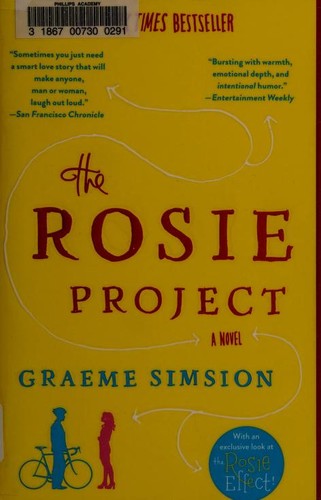
Don Tillman is a genetics professor who has never quite understood why other people find him odd. He has rigid routines, a rotating meal schedule, and a talent for optimizing almost everything — except his social life. Convinced that a scientific approach will solve the problem of finding a wife, he designs the Wife Project: a detailed questionnaire that will weed out incompatible candidates and deliver a maximally suitable partner. What he could not have anticipated is Rosie Jarman, who fails every one of his criteria and yet keeps appearing in his life.
The book is a comedy about what happens when someone with what is heavily implied to be undiagnosed autism — Don is never labeled in the text — tries to solve a human problem with the tools that have served him everywhere else. But it is also something more serious: a novel about how rigid self-knowledge can be both a superpower and a blindspot. Don's precision and honesty are genuinely useful, and Simsion treats them as such rather than simply mocking them. The tension is between the life Don has designed around his nature and the life he might have if he let the design loosen.
What distinguishes the book from the long line of quirky-genius love stories is that Don is not a fantasy. He is sometimes exhausting, often oblivious, and completely wrong about what he wants. Simsion's biggest achievement is making those qualities funny without making Don a figure of pity or ridicule. The prose stays firmly inside Don's literal, cataloging voice, which generates most of the humor and, when things go wrong, most of the pathos.
Readers who find this kind of narrative irresistible — reliable narrator who doesn't know what the reader knows — will race through it. Readers who need psychological interiority from their protagonists may find Don frustrating. It is a light book with a real heart, better company than it probably sounds in summary.
The big ideas
- 1.
Don's failure mode — treating every problem as an optimization exercise — is also what makes him effective at his job and honest in his relationships.
- 2.
The novel argues, gently, that social fluency is a skill built on convention rather than substance; Don repeatedly exposes how arbitrary many conventions are.
- 3.
Rosie is not a manic-pixie figure. She has her own reasons for spending time with Don, and they are not flattering to her in the early going.
