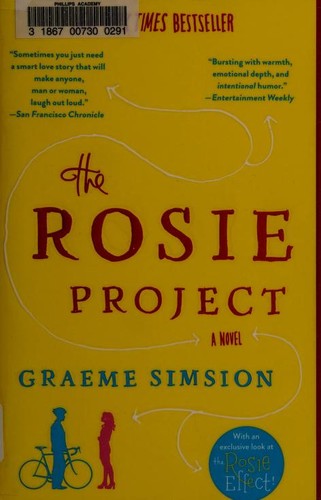
The Rosie Project by Graeme Simsion is a 2013 contemporary fiction book about neurodiversity and identity, love and self-discovery, social convention. Don's failure mode — treating every problem as an optimization exercise — is also what makes him effective at his job and honest in his relationships.
Summary
Don Tillman is a genetics professor who has never quite understood why other people find him odd. He has rigid routines, a rotating meal schedule, and a talent for optimizing almost everything — except his social life. Convinced that a scientific approach will solve the problem of finding a wife, he designs the Wife Project: a detailed questionnaire that will weed out incompatible candidates and deliver a maximally suitable partner. What he could not have anticipated is Rosie Jarman, who fails every one of his criteria and yet keeps appearing in his life.
The book is a comedy about what happens when someone with what is heavily implied to be undiagnosed autism — Don is never labeled in the text — tries to solve a human problem with the tools that have served him everywhere else. But it is also something more serious: a novel about how rigid self-knowledge can be both a superpower and a blindspot. Don's precision and honesty are genuinely useful, and Simsion treats them as such rather than simply mocking them. The tension is between the life Don has designed around his nature and the life he might have if he let the design loosen.
What distinguishes the book from the long line of quirky-genius love stories is that Don is not a fantasy. He is sometimes exhausting, often oblivious, and completely wrong about what he wants. Simsion's biggest achievement is making those qualities funny without making Don a figure of pity or ridicule. The prose stays firmly inside Don's literal, cataloging voice, which generates most of the humor and, when things go wrong, most of the pathos.
Readers who find this kind of narrative irresistible — reliable narrator who doesn't know what the reader knows — will race through it. Readers who need psychological interiority from their protagonists may find Don frustrating. It is a light book with a real heart, better company than it probably sounds in summary.
Talk to The Rosie Project like its author wrote you back.
Get the ideas that fit your life — not generic summaries.
- Chat with the book
- Audiobook-style main ideas
- Adapts to your life and goals
- Helps you take action
Key takeaways
- 1.
Don's failure mode — treating every problem as an optimization exercise — is also what makes him effective at his job and honest in his relationships.
- 2.
The novel argues, gently, that social fluency is a skill built on convention rather than substance; Don repeatedly exposes how arbitrary many conventions are.
- 3.
Rosie is not a manic-pixie figure. She has her own reasons for spending time with Don, and they are not flattering to her in the early going.
- 4.
The Wife Project is funny, but its premise — that compatibility can be assessed by questionnaire — is not entirely wrong, which is what makes it more than a joke.
- 5.
Simsion uses Don's literal mind to get at things that social fiction usually papers over: how much of what people say they want is not what they actually want.
- 6.
The book is kind to neurodiversity without being earnest about it. Don is never a poster child for autism acceptance; he is just himself.
- 7.
Friendship — the subplot involving Don's friend Gene — is as important as the romance, and considerably more complicated.
- 8.
Love, in this book's accounting, is not chemistry at first sight but a series of decisions to keep showing up despite mounting evidence that you shouldn't.
Discussion questions
Use these on your own, with a book club, or as chat starters in Superbook. Book club version, ready to copy or print →
- 1.
Don never receives a formal diagnosis in the novel. Does keeping the label absent make the portrayal more or less effective? What would change if he were explicitly identified?
- 2.
The Wife Project questionnaire is absurd, but Don's logic for designing it isn't. Which of his criteria are actually reasonable, and which reveal blind spots?
- 3.
Rosie treats Don instrumentally for much of the book — using him to solve her own problem. Is that fair? Does the novel judge her for it?
- 4.
Don changes over the course of the book, but does he change fundamentally, or just tactically? Is the ending satisfying on those terms?
- 5.
Gene has affairs with his wife's apparent awareness. The book doesn't quite condemn this. What do you make of how it's handled?
- 6.
Don's rituals and schedules are presented as something to work around in a relationship. Do you read that as a compromise or as a loss for Don?
- 7.
The novel is narrated entirely from Don's perspective, which means we only hear his interpretation of what others think. What might Rosie's version of events look like?
- 8.
Several characters tell Don he is different without explaining how or why. How does that experience — knowing you're different without being told the terms — shape a person?
- 9.
The book is a comedy, but it skirts close to loneliness several times. Which scene or moment did you find most unexpectedly affecting?
- 10.
Don is professionally distinguished. Would the novel work if he were less successful — if his intelligence and rigor were traits he had without the career to validate them?
- 11.
Compared to a book like Normal People, where the central couple's incompatibility is agonizing, where does The Rosie Project land? Is this a more or less honest portrait of a relationship?
- 12.
By the end, has Don actually learned to read people better, or has he learned to manage his responses to them? Is there a meaningful difference?
Themes
Frequently asked questions
-
Is The Rosie Project worth reading?
Yes, if you like character-driven comedy with genuine warmth. Don Tillman is one of the more memorable first-person narrators in recent popular fiction, and the book moves fast enough that its lighter moments don't outstay their welcome. It is not a deep novel, but it is a consistently enjoyable one.
-
Is The Rosie Project part of a series?
Yes. It is the first of three novels. The Rosie Effect follows Don and Rosie's marriage and impending parenthood; The Rosie Result deals with their son's school experience. The first book is self-contained; the sequels are lighter and somewhat thinner.
-
What is The Rosie Project about, without spoilers?
A genetics professor with rigid social habits tries to find a wife using a scientific questionnaire, and instead meets someone who fails every criterion he set. It is a comedy about rationality, routine, and the things love disrupts.
-
Is Don Tillman autistic?
He is never diagnosed in the text, but the portrayal draws heavily on autism and Asperger's syndrome. Simsion has discussed this openly in interviews. The decision to leave Don unlabeled was deliberate — the novel focuses on who Don is rather than what category he fits.
-
Who shouldn't read The Rosie Project?
Readers who need moral complexity or psychological depth from their fiction will probably find it thin. The book is earnestly sweet and the ending is tidier than life. If you are looking for something that challenges you, look elsewhere.