Philosophy · Book club
The Sacred and the Profane book club questions
Here are 11 book club questions for The Sacred and the Profane by Mircea Eliade, ordered to open easily and end somewhere worth arguing about. Copy them, print them, or bring them up one at a time.
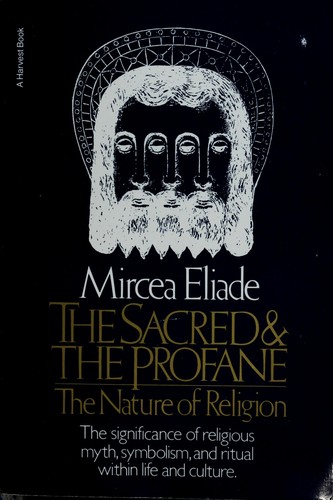
The Sacred and the Profane is Mircea Eliade's most accessible introduction to his life's central argument: that religious experience is a distinct mode of being in the world, irreducible to sociology, economics, psychology, or any other secular explanatory framework.
Mircea Eliade · 1957 · 4h 20m
Full summary and key takeaways →The 11 questions
- 1.
Eliade argues that sacred and profane are not just categories of objects but modes of being. What would it mean to inhabit the world in the way he describes as 'religious'?
- 2.
Do you have places in your own life that function as sacred space — not in a formally religious sense, but as charged, orienting, different from ordinary space? What makes them feel that way?
- 3.
Eliade says religious time is cyclical and recoverable — ritual makes the original sacred moment present again. Does that account help explain the emotional power of annual rituals or celebrations in your own life?
- 4.
Myth, in Eliade's sense, is the most real narrative — the one that establishes patterns for everything else. What stories function as myth in contemporary secular culture?
- 5.
Eliade argues that modern secular humans have relocated the sacred rather than eliminated it. Where do you see that displacement in contemporary life?
- 6.
For religious humanity, the natural world — sun, water, earth — carries symbolic depth. What would it change in daily experience to inhabit the natural world that way?
- 7.
Eliade's framework has been criticized for overgeneralizing across wildly different cultures. Is that a fatal problem for his argument, or does the general framework still hold despite the specifics?
- 8.
What do initiation rituals in contemporary secular life — graduation, marriage, military service — share with the pattern Eliade describes? What do they lack?
- 9.
Eliade seems to view modernity's desacralization with a degree of regret. Do you share that regret? What is actually lost when the world becomes profane?
- 10.
The axis mundi — the center of the world — appears in wildly different cultures. Why might the human mind need to experience the world as having a center?
- 11.
If the sacred is persistent and merely migrates when traditional religion declines, what are the practical consequences for how we understand contemporary politics, consumerism, or nationalism?
How to run the discussion
- Pick six to eight, not all of them. An hour of real discussion covers fewer questions than anyone expects, and racing the list is what makes a book club feel like homework.
- Open with what people noticed, not what they concluded. Asking for a verdict first hardens opinions before anyone has heard each other.
- Let the disagreement run. The questions below that split a room are the ones worth the time; the ones everyone answers the same way can be skipped.
- Ask the quiet person a specific question. A direct, narrow question is far easier to answer than an open invitation to contribute.
Themes worth steering toward
If the conversation stalls, these are the threads that usually restart it.
Common questions
What are good book club questions for The Sacred and the Profane?
Here are 11 book club questions for The Sacred and the Profane by Mircea Eliade, ordered to open easily and end somewhere worth arguing about. The strongest openers ask what each reader noticed rather than what they concluded, and the discussion usually turns on sacred space, myth, religion.
How long should a book club discussion of The Sacred and the Profane last?
Most groups run 60 to 90 minutes of actual discussion. That is roughly six to eight questions, not all of them, so pick the ones that suit your group rather than working down the list in order.
What are the main themes in The Sacred and the Profane?
Sacred space, Myth, Religion, Time, Ritual. Those are the threads most likely to divide a room, which makes them the useful places to steer a discussion that has gone quiet.
Picking the next one? See books like The Sacred and the Profane or questions for other book club picks.
