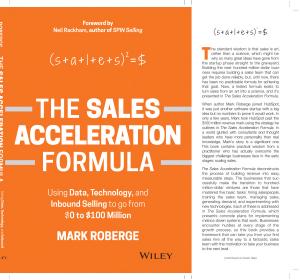
Talk to The Sales Acceleration Formula like its author wrote you back.
Get the ideas that fit your life — not generic summaries.
- Chat with the book
- Audiobook-style main ideas
- Adapts to your life and goals
- Helps you take action
The Sales Acceleration Formula, in detail
Mark Roberge was HubSpot's first sales hire and eventually its Chief Revenue Officer, scaling the company from zero to over $100 million in recurring revenue. The Sales Acceleration Formula is his account of how he approached sales as an engineering problem — hiring, training, onboarding, managing, and compensating by metrics rather than intuition, and measuring everything to find what actually produced predictable revenue growth.
Roberge's starting point is that most early-stage sales hiring is guesswork. Founders or early sales leaders hire people who remind them of successful salespeople they've known, or who interview well, without knowing which traits actually predict success in their specific context. His approach was to define a hiring formula by identifying the attributes that correlated with performance at HubSpot — curiosity, intelligence, work ethic, coachability, and prior success — and then building an interview and scoring process to assess them consistently across candidates.
The same data-driven approach extends to training and onboarding (measuring exactly how long it takes a new rep to reach full productivity and optimizing that timeline), sales management (using leading indicators to coach reps earlier in the funnel rather than after the quarter closes), and demand generation (building a lead scoring model that quantifies which inbound activities predict purchase readiness). Each element is a formula that can be tested, measured, and improved.
The book is most useful for sales leaders at B2B SaaS or technology companies who have product-market fit and are ready to scale. The context is specific: inbound-heavy, software sales, and a company culture with the appetite to build measurement systems from scratch. The prescriptions don't translate directly to transactional, outbound-only, or non-software environments without adaptation. But the underlying principle — that sales should be managed by leading indicators and hypothesis testing, not intuition and hope — applies widely.
The big ideas
- 1.
Hiring the right salespeople is the highest-leverage activity in sales leadership. A wrong hire costs not just salary but sales cycle time, management attention, and team morale.
- 2.
The hiring formula should be empirically derived from your best performers, not borrowed from a general sales playbook. The traits that predict success at one company often don't transfer to another.
- 3.
Time to full productivity is a measurable, optimizable number. Every week a new rep spends below quota represents lost revenue that better onboarding and training could have recovered.
